The First Production Corvette
The Evidence Behind Chevrolet’s Lost VIN 001
By Brad Burdick
For nearly twenty years, an unfinished 1953 Corvette sat forgotten in a shipping container behind a restoration shop in Tulsa, Oklahoma. To almost everyone who saw it, it was simply another early Corvette waiting its turn. Corey Peterson thought otherwise. Years spent studying Chevrolet engineering records eventually convinced him the neglected car was not simply an early Corvette. It might be the first production Corvette ever built.
For more than seventy years, many Corvette enthusiasts—and even historians—believed the first production Corvette no longer existed. When I first heard that someone may, in fact, have found it, I was intrigued to say the least. I began reading every article I could find, watched hours of videos of Corey discussing the car, and soon found myself caught up in the excitement of what could be one of the most important Corvette discoveries ever.
I first met Corey at the National Corvette Museum in August 2023, where the car was displayed during the Corvette Hall of Fame induction of John Amgwert. John is NCRS member #3, one of the organization’s founding members, and for approximately twenty-five years served as editor and principal writer of NCRS’s official publications and communications, including newsletters, magazines, judging materials, brochures and related documents. He is a recipient of the NCRS Lifetime Achievement Award and a member of the Corvette Hall of Fame. John specifically wanted this car onstage during his induction.
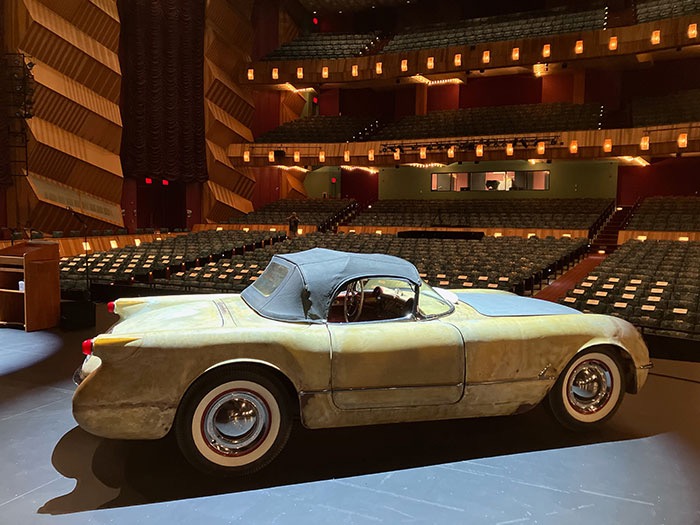
Car #3950 onstage during John Amgwert’s 2023 Corvette Hall of Fame induction.
The Cars That Were Destroyed
One reason this claim has been so difficult for many people to accept is the long-held belief that the earliest Corvette—or perhaps the earliest Corvettes—had been destroyed. John Amgwert’s 1993 article, “The Earliest Corvettes,” published in The Corvette Restorer (Summer 1993, Vol. 20, No. 1), helps clarify that point. The cars known to have been destroyed were the first two experimental Motorama “show car” prototypes, EX-52 and EX-53. That is not the same as saying Production Cars #1 and #2 were destroyed.
Chevrolet originally planned five experimental Corvettes under Project Opel, designated 852 through 856, although only three were completed as cars. Car 852 became EX-52, the principal Motorama show car displayed in the United States. Car 853 became EX-53, commonly known as the Canadian Motorama show car. Car 856 remained Chevrolet’s experimental development and test car at the Milford Proving Ground. These experimental cars were separate from the production Corvettes that began with VIN E53F001001.
Chevrolet records document the scrapping or destruction of the experimental Motorama show cars. No available document, however, has been identified that records the destruction of either of the first production Corvettes.
I believe much of the confusion began there. Over time, the destruction of the first two prototypes seems to have become blended with the assumed destruction of the first two production cars. Putting that distinction to rest does not prove VIN 001 survived, but it removes one of the main reasons many people believed it could not have survived.
Corey Peterson and the Search for #3950
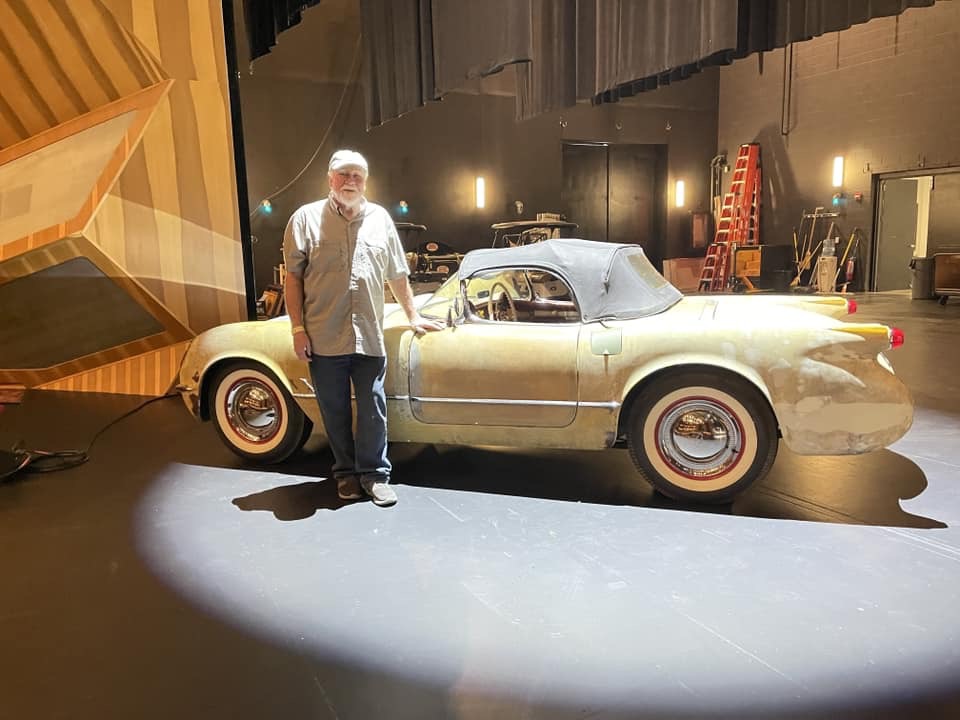
Corey Peterson with Car #3950.
Corey Peterson is an accomplished Corvette historian with a particular focus on the earliest production cars. He co-founded the NCRS Bonneville Chapter in 1992—one of four people who established it—and has been a dedicated NCRS member for over 50 years. He was recently elected Regional Director for Region 6, a reflection of the respect he has earned through decades of research and contribution to the Corvette community. His focus on Corvette’s first years has given him an understanding of these cars that few people alive can match.
It was that expertise—combined with years of patient, methodical work through GM’s own internal documentation—that led him to a restoration shop in Tulsa, Oklahoma, and a car that had sat untouched for nearly twenty years. What he found there, and what he has assembled since, represents one of the most carefully documented automotive identity claims in Corvette history.
I had the privilege of spending a couple of days with Corey—not only to learn about his journey, but to examine the evidence on the car and review the historical Chevrolet documents that support what we now believe is the very first production Corvette, built on June 30, 1953. Corey’s detailed command of the records impressed me. He could cite a work order, explain why it was issued, and then walk over to the car and point to the physical evidence that matched it.
What follows is Corey Peterson’s story: the documents, the physical evidence and the process of elimination that led him to believe he has found VIN 001.
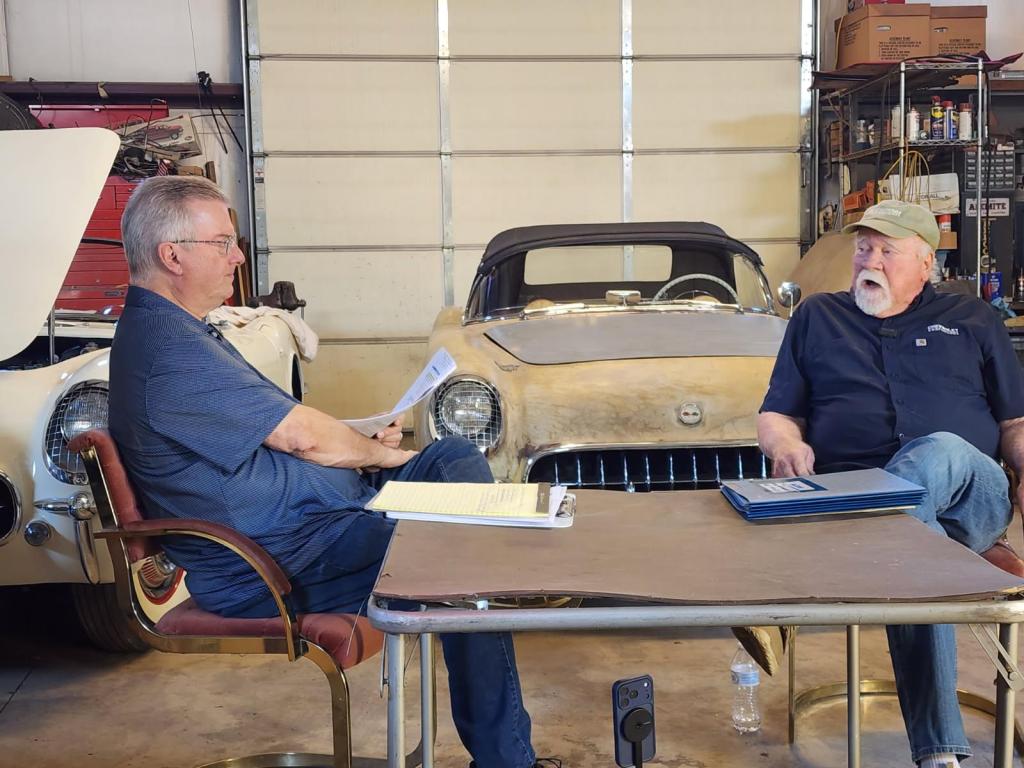
The author, left, reviewing Chevrolet documentation with Corey Peterson. Photo courtesy of Candace Balcom-Paulino.
When news of the discovery became public in 2023, the reaction was immediate. Some believed the evidence was compelling. Others remained skeptical. That skepticism is healthy. A claim this important deserves serious scrutiny.
Several experienced Corvette people examined the car during the years it sat at the Tulsa restoration shop and believed it was a very early 1953. But because of the unusual changes made to the body, they were not certain what they were seeing. It took Corey, years later, to locate and assemble the Chevrolet records that identify the surviving car as Engineering Car #3950—and raise the larger question of whether #3950 was VIN 001.
Despite the attention the car has received, no authoritative body has issued a definitive determination, and no contrary documentary identification has been publicly presented. Corey has repeatedly invited current NCRS officials, judges and recognized Corvette experts to examine the car and its supporting records.
Until now, the complete body of evidence has never been brought together and presented for the Corvette community to evaluate. NCRS judging is designed to determine whether a production Corvette has been restored correctly—not whether an early engineering and development car can be identified by piecing together factory records, documented engineering changes, and the surviving car itself. That’s the challenge this investigation presents. My hope is this article will encourage knowledgeable Corvette historians and enthusiasts to take a fresh look at the evidence and continue the investigation.
Identity, Originality and the Car as It Exists Today
The car does not exist today exactly as it left the assembly plant in Flint, Michigan. Its paint was stripped to bare fiberglass during earlier work on the car, leaving a mottled look that some people mistake for rust—even though fiberglass cannot rust. Its frame and engine are not original to the body, and the VIN plate was not attached when Corey acquired it. Those facts need to be stated plainly.
But they also raise an important distinction. Whether the car is configured today exactly as it left Flint is not necessarily the same question as whether the surviving body is the historically significant car Chevrolet knew as Engineering Car #3950.
Identity, configuration and originality are not the same thing. A replacement frame affects originality. A replacement engine affects configuration. Neither automatically answers the most important question in this investigation: Which body is this?
A Corvette Rushed Into Production
At the January 1953 Motorama, Chevrolet publicly committed to having the Corvette in production by June. That compressed what would normally have been a much longer development process—often years—into only a few months. Production began while many details were still being evaluated.
Several of the earliest Corvettes were retained within Chevrolet and GM for engineering and testing rather than being sold through normal dealerships. Chevrolet referred to much of this work as “design check”—installing and evaluating proposed parts or revisions on an actual car before approving them for broader production.
Where the First Nine Cars Went
The first nine production Corvettes did not all follow the same path. Three went to Chevrolet Engineering, three went to GM Engineering personnel, and three went to DuPont executives. Henry DuPont was a close friend of Harley Earl, the Father of the Corvette.
| Production Car | Internal Assignment |
| #1 | Chevrolet Engineering — #3950 |
| #2 | Chevrolet Engineering — #3951 |
| #3 | GM Engineering — ES-127-1 |
| #4 | J. Spencer Weed — DuPont friend |
| #5 | Crawford Greenewalt — DuPont executive |
| #6 | Henry B. DuPont — DuPont executive |
| #7 | Chevrolet Engineering — #3953 |
| #8 | GM Engineering — ES-128-2 |
| #9 | GM Engineering — ES-129-3 |
Those assignments matter because some proposed revisions were later extended to other engineering Corvettes. A single modification may narrow the field to the engineering group, but no other known Corvette retains the complete pattern of documented changes found on Corey’s car. The records and the histories of the individual cars are then needed to narrow the field further.
Chevrolet’s Paper Trail for Engineering Car #3950
Chevrolet assigned the first production car the internal engineering number #3950. The “3” represented the 1953 model year, “9” identified Corvette, and “50” was the first number in the sequencing. The next Chevrolet Engineering car became #3951, while Production Car #7 became #3953.
A Production Development Car
A June 16, 1953 Chevrolet Engineering work order called for a Model 2934 Corvette Sport Roadster to be assigned #3950 and used as a Proving Ground development car, replacing experimental Corvette #856.
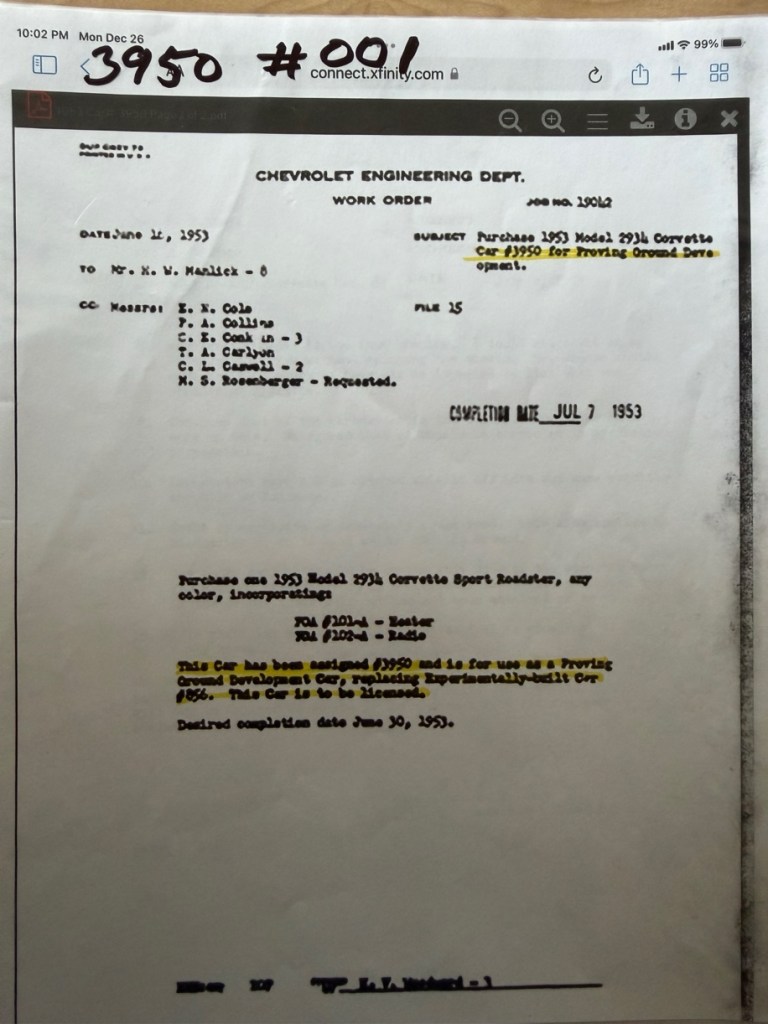
Chevrolet Engineering Work Order 19042, dated June 16, 1953, assigning Car #3950 as a Proving Ground development car to replace experimental Car #856.
A separate Chevrolet memo distinguished “the production Corvette, Car #3950” from experimental Corvette #856. The distinction matters: Chevrolet continued to identify #856 as experimental while calling #3950 the production Corvette.
Production Car #1 Goes to Work
A July 7 memorandum from H. F. Barr to Chevrolet Chief Engineer E. N. Cole reported that the “#1 Production Corvette” was undergoing a 1,000-mile break-in, with C. L. Caswell documenting complaints and suggested improvements. Three days later, Caswell submitted complaint sheets titled “Complaints on #3950 Corvette.” The two records provide another connection between Chevrolet’s No. 1 production car and Engineering Car #3950.
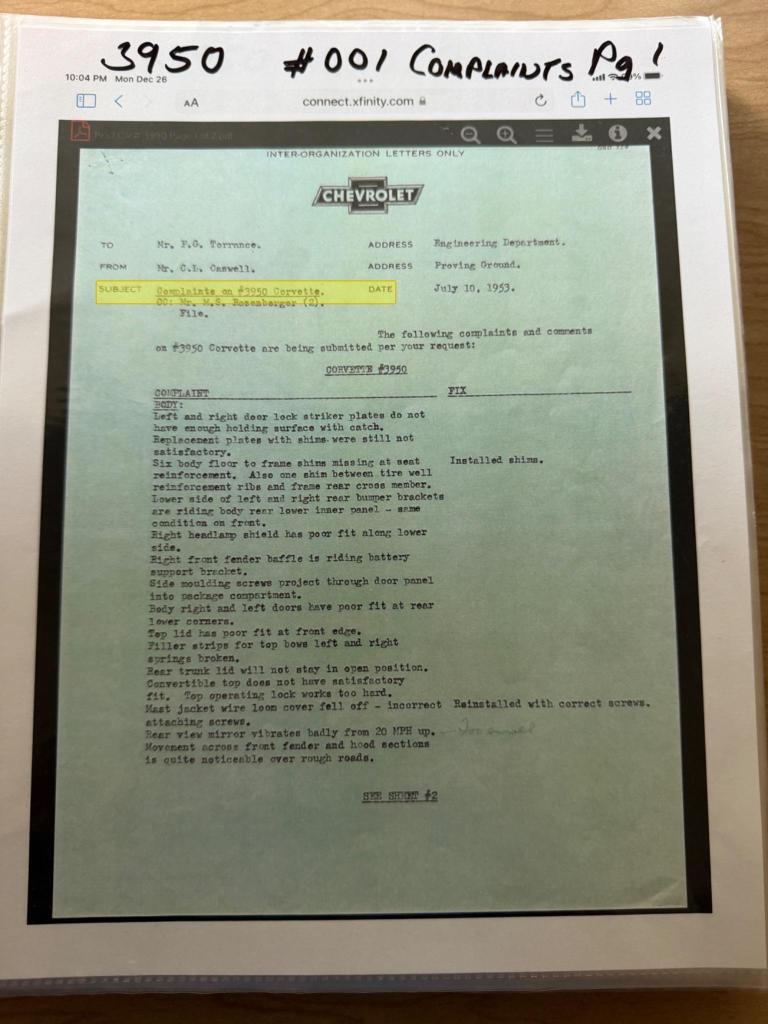
Page 1 of C. L. Caswell’s July 10, 1953 “Complaints on #3950 Corvette.”
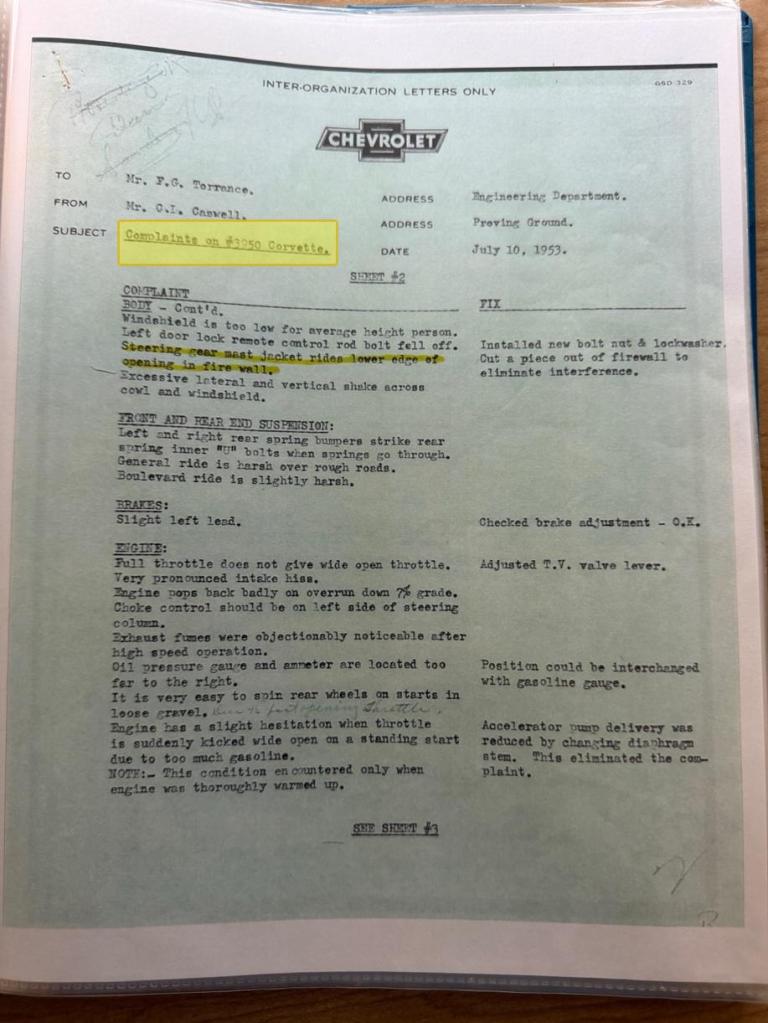
Sheet 2 of C. L. Caswell’s July 10, 1953 “Complaints on #3950 Corvette.”
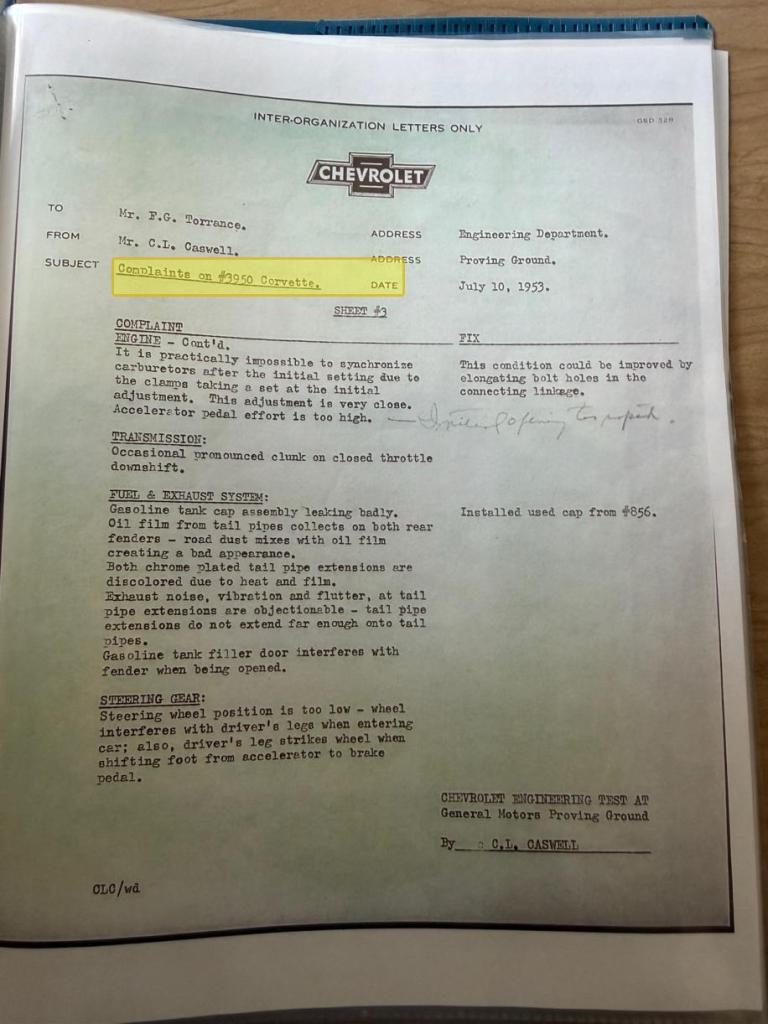
Sheet 3 of Caswell’s complaint report.
From Complaints to Changes
The complaint reports led to engineering discussions, proposed solutions, work orders and physical modifications. A July 28 work order called #3950 the “first production Design Check Car.”
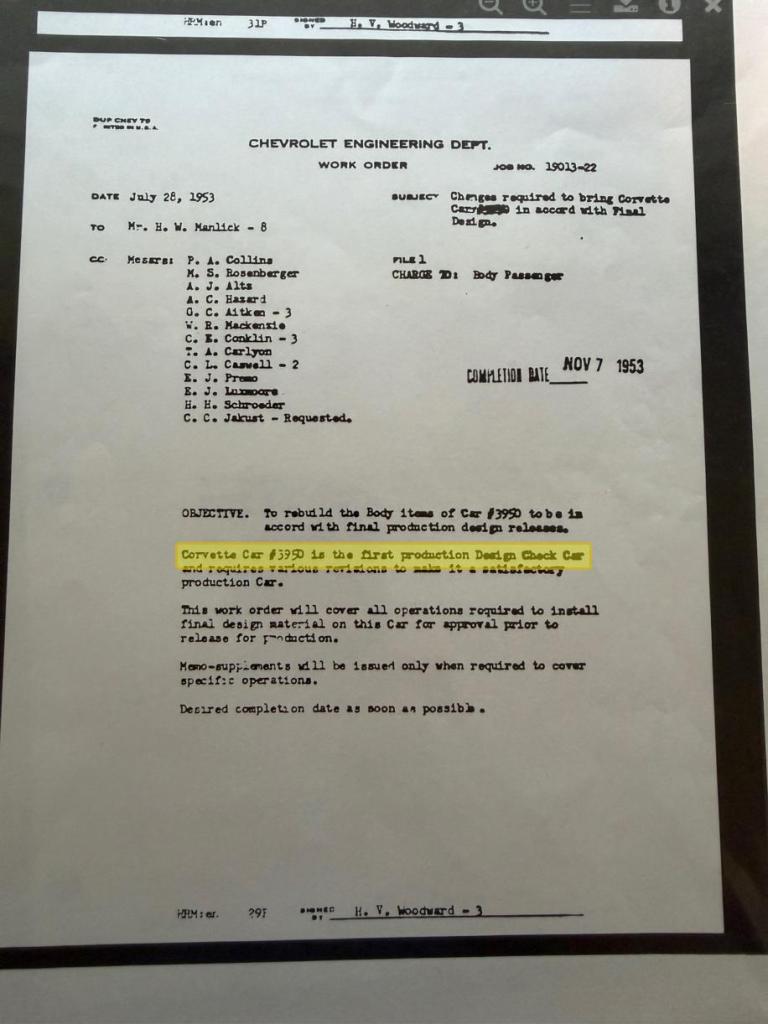
Chevrolet Engineering Work Order 19013-22, dated July 28, 1953, identifying Car #3950 as the first production Design Check Car.
An August 6 supplement made the relationship even clearer, referring directly to:
“Car #3950 (#1 production).”
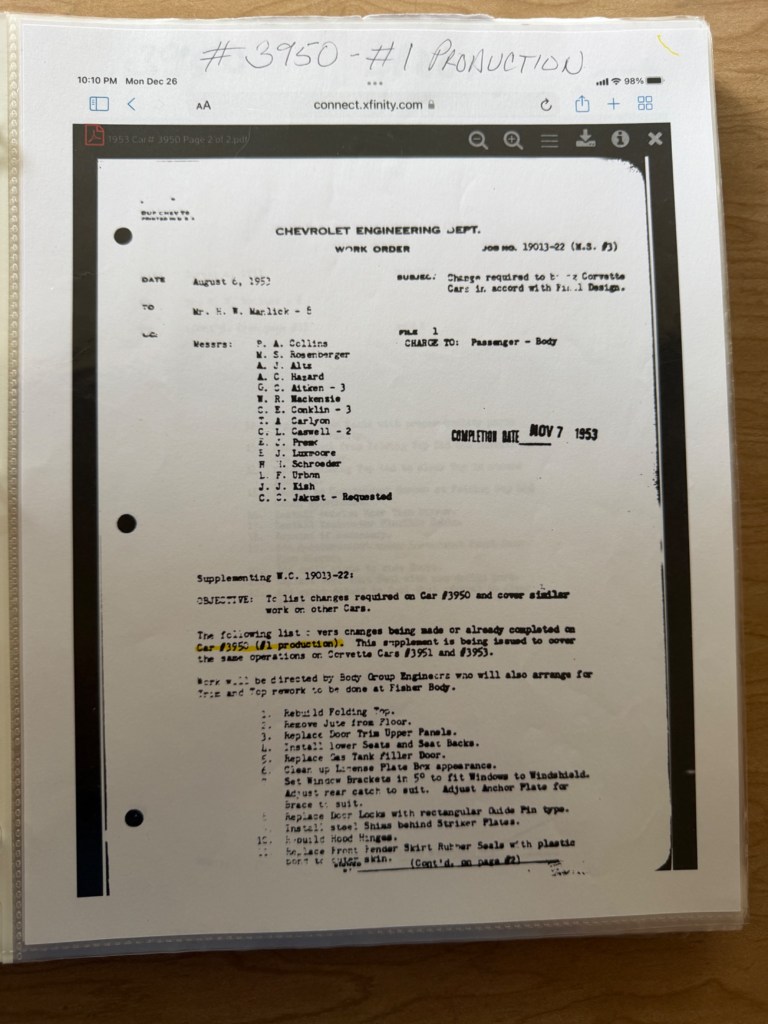
August 6, 1953 work-order supplement containing the key notation “Car #3950 (#1 production).”
That short line is one of the most important in the entire record. In Chevrolet Engineering’s own working paperwork, #3950 and Production Car #1 are identified as the same car.
As the first production car, it became Chevrolet’s primary test vehicle, generating complaints that led to suggested changes, engineering evaluations, work orders and modifications.
Engineering Review of the Fixes
Even Ed Cole, Chevrolet’s Chief Engineer, drove and evaluated the No. 1 Production Corvette. More importantly for identifying the car and its changes, an August 6, 1953 memorandum from T. J. Soroka to E. J. Premo stated that a group of proposed changes would be shown for approval on Corvette Car #3950 at the Experimental Garage. The listed items included the license-plate box appearance, gas-tank door, outside rear-view mirror, stronger quarter-panel mounting bracket, stronger deck-lid springs and changes intended to eliminate wear on the seat.
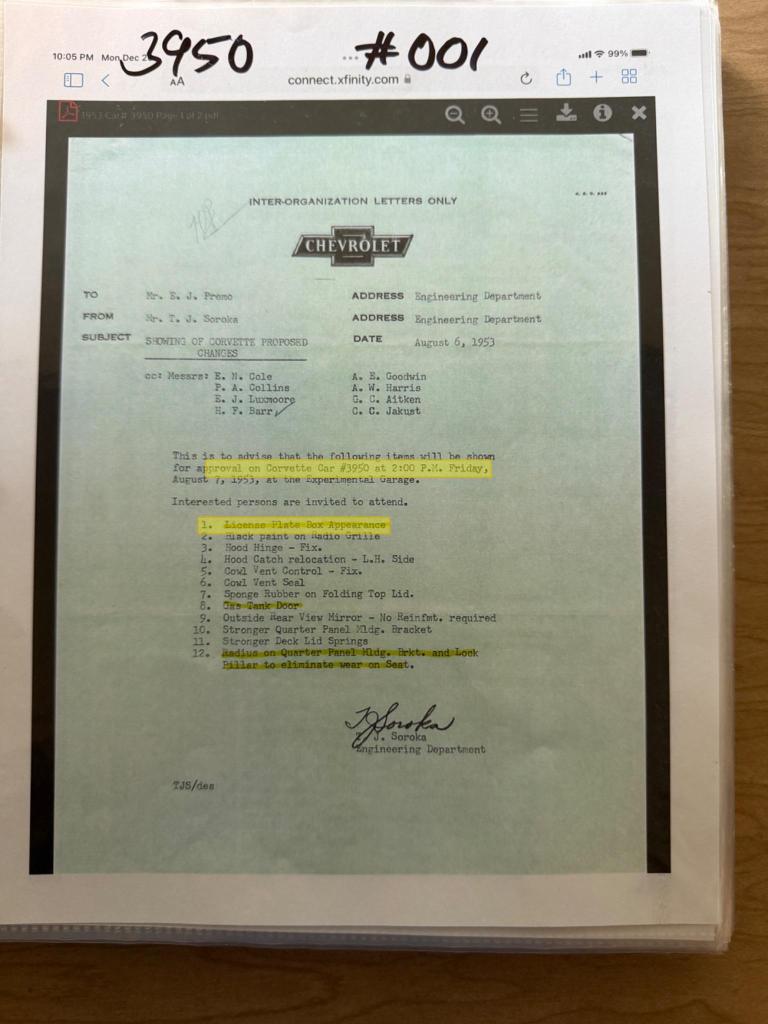
T. J. Soroka’s August 6, 1953 memorandum listing proposed changes to be shown for approval on Corvette Car #3950.
As Corey Peterson walked me through Chevrolet’s records, one thing became increasingly difficult to ignore. He had arranged the documents chronologically, and when viewed, the same engineering car kept appearing—first in a requisition, then in complaint reports, then in engineering memos, then in work orders. None of those documents was written to identify VIN 001. Together, however, they begin telling the story of the same engineering car—a story that Chevrolet’s own records repeatedly identify as #1 production.
Viewed individually, they looked like unrelated repairs. Viewed together, they looked like the unmistakable fingerprints of Chevrolet Engineering.
If Chevrolet’s records consistently identify Engineering Car #3950 as #1 production, the obvious question becomes: Was #1 production the car carrying serial number E53F001001? That is where the direct documentary record stops, and where the physical evidence, provenance and histories of the other early cars become essential.
The One-Piece Floor Pan
One of the most important physical facts about Corey’s Corvette is its one-piece floor pan. This is not a cosmetic feature, a piece of trim or a bolt-on part that could easily be transferred from one car to another. It is a major functional part of the fiberglass body itself—essentially the foundation of the body.
Steve Koss’s article, “General Motors Parts Fabrication,” published in The Corvette Restorer Magazine (Winter 1988, Vol. 14, No. 3), helps explain just how difficult that first design was to produce. Koss worked in GM’s Parts Fabrication group and described the floor pan as one of the major structural panels in the body. It was made as a five-cloth laminate that included the toe pan, dash panel and full tunnel. The first one required sixteen continuous hours of hand lay-up.
By 1953, the Parts Fabrication group was making about one and a half one-piece floor pans per day and was barely able to keep up, even while working weekends. To raise production to three floor pans per day, Chevrolet changed to eight separate sections—including the wheelhouses, tunnel, rocker panels and spare-tire compartment—which were placed into the large floor-pan mold and bonded together along their seams.
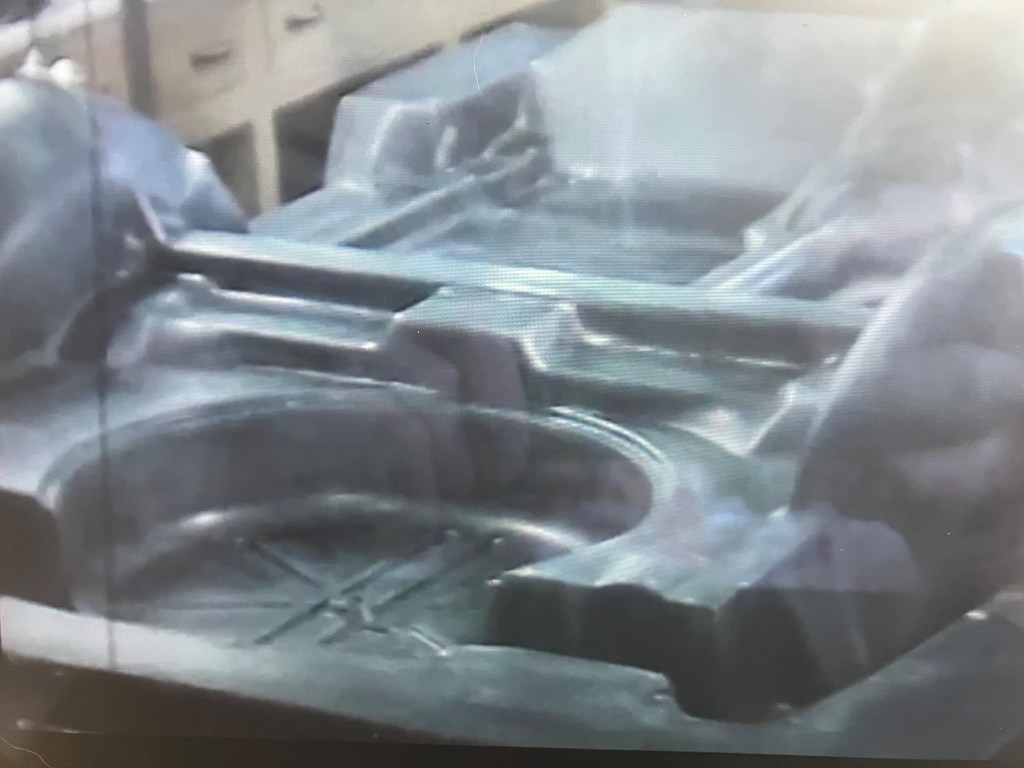
The dark form shown here is the mold used to create the floor pan—not a completed floor pan.
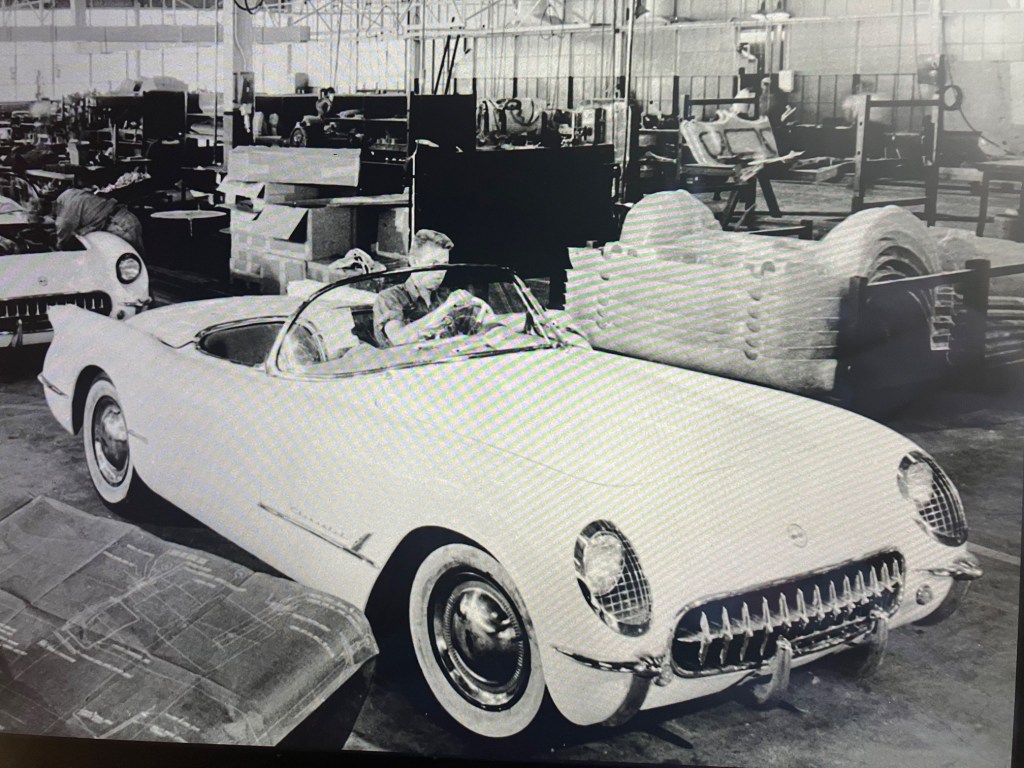
One of the first few Corvettes on the Flint assembly line. Behind it is a stack believed to contain completed one-piece floor pans.
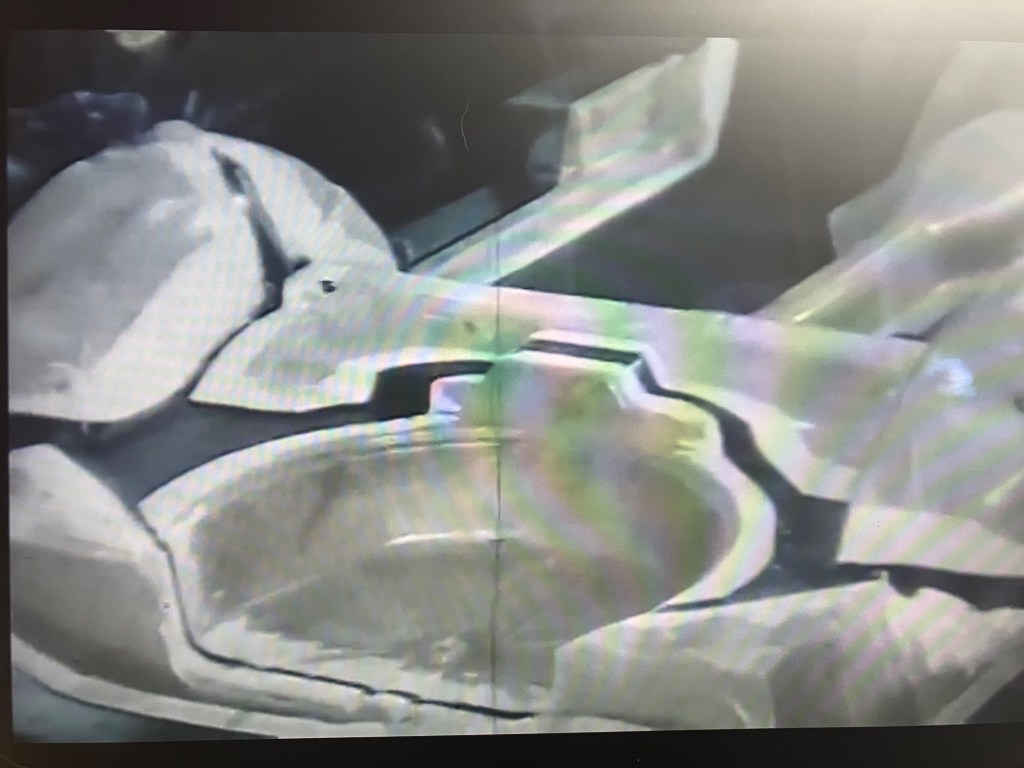
The eight separate fiberglass sections positioned for assembly in the floor-pan mold. The pieces were bonded together along their seams.
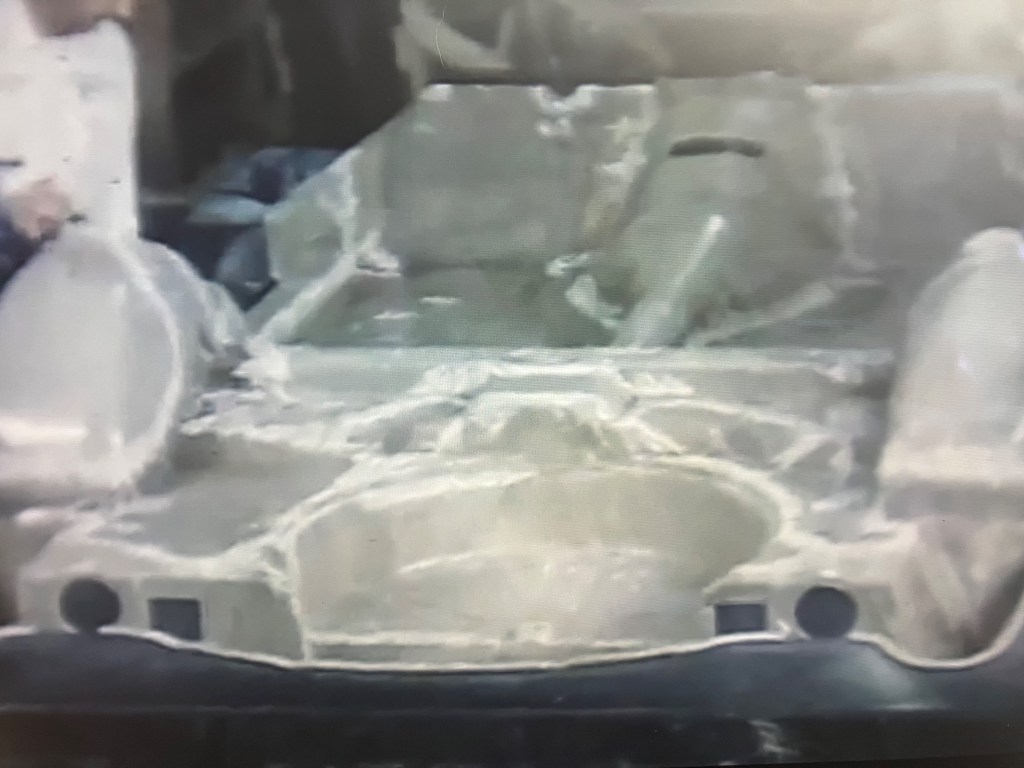
A completed eight-piece floor pan. The bonded seams between the individual sections remain visible throughout the structure.
Based on Corey’s work with Lynn Libby and other early-Corvette researchers, the one-piece floor was used only on roughly the first fifteen to twenty production cars. It does not identify the Tulsa body as #3950 by itself. It does something equally important: it places the body among a very small group of the earliest Corvettes built.
Accounting for the First Twenty Corvettes
The one-piece, hand-laid floor pan in Corey’s Corvette establishes that the body belongs within the very small group of approximately the first fifteen to twenty production Corvettes. Examining where those first twenty cars currently reside narrows the possibilities significantly.
Corey did not begin with the Tulsa car and try to make every fact fit. He worked through the earliest production Corvettes one by one, comparing ownership histories, engineering assignments, body construction and surviving documentation. The following list summarizes the best information presently available. “Documented” is used where the car’s present location or ownership has been established through Corey’s research; it does not imply that every detail of its history is complete. If anyone has additional or more recent information that would correct or update this list, please provide it so the record can be made as accurate as possible.
| Car | Known disposition | |
| 20 | E53F001020 | Broadmoor Hotel courtesy car, Colorado Springs; current survival not fully confirmed. |
| 19 | E53F001019 | Owned by George Walloff and later sold to Lynn Libby, documented in Pennsylvania. |
| 18 | E53F001018 | Documented with Bruce Hanson in California. |
| 17 | E53F001017 | Documented with Lynn Libby in Pennsylvania; formerly James Kochi of New Jersey. |
| 16 | E53F001016 | Documented with Tom and Nancy Greve in Florida. |
| 15 | E53F001015 | Documented in the Reale family; originally Anthony Reale of Pennsylvania. |
| 14 | E53F001014 | Documented through the General Donald Yates/Stohlman Chevrolet history and later ownership records. |
| 13 | E53F001013 | Documented with Greg Wynn in Arizona. |
| 12 | E53F001012 | Documented in Illinois with longtime owner William Hiller. |
| 11 | E53F001011 | Documented in Ohio. |
| 10 | E53F001010 | No confirmed surviving history; status unknown, but no evidence it was an engineering car. |
| 9 | E53F001009 | GM Engineering Car ES-129-3; documented with Randy Snyder in Indiana. |
| 8 | E53F001008 | GM Engineering Car ES-128-2; documented in the Rinke collection in Michigan. |
| 7 | E53F001007 | Chevrolet Engineering Car #3953; Chevrolet records directly identify it as E53F001007; reported to reside in Indiana. |
| 6 | E53F001006 | DuPont executive car; documented in Pennsylvania. |
| 5 | E53F001005 | DuPont executive Crawford Greenewalt’s car; documented in Michigan. |
| 4 | E53F001004 | DuPont-associated car; documented in the Rinke collection in Michigan. |
| 3 | E53F001003 | GM Engineering Car ES-127-1; body on a replacement frame in the Ressler family collection in Montana. The original frame was considered scrap due to extreme testing and is displayed at the National Corvette Museum as part of a cutaway exhibit by Kevin MacKay. |
| 2 | E53F001002 | Chevrolet Engineering Car #3951; later converted into the 1955 V8 car and re-serialed EX-122; currently in New Jersey. |
| 1 | E53F001001 | Chevrolet Engineering Car #3950; the subject of this investigation. |
Eighteen of the first twenty production Corvettes are accounted for or documented. The two whose present survival is not fully established—Cars #10 and #20—were not among the six engineering cars identified in GM documentation. That does not prove the Tulsa car is #1, but it removes two otherwise unidentified cars from the engineering-car comparison.
The Car #003 Confusion
Car #003 had a particularly interesting life and later became central to the “oldest surviving Corvette” story. In 1969, Corvette News conducted a survey seeking the oldest surviving Corvette. Car #003 was the oldest known respondent to the survey at the time. Following extensive suspension stress testing by Chevrolet Engineering, the frame was removed due to concerns about fatigue. To ensure safety, a new frame and suspension components were installed, and the car is now in the Ressler family collection.
That finding did not prove Cars #001 and #002 had been destroyed. It meant only that #003 was the earliest car reported in that particular search.
The Physical Evidence on the Car
Chevrolet’s documents tell us what problems its engineers found and what changes they wanted. The surviving body allows those changes to be compared directly with the car.
Lowered “A” Point, Seat and Steering-Column Clearance
One of the earliest complaints involved driver leg clearance behind the large steering wheel. Chevrolet called for lowering the seat and lowering the “A” point—the platform on which the seat rests—by 3/4 inch. The corresponding area on Corey’s car is lowered precisely 3/4 inch.
The car also retains the enlarged dash opening associated with the effort to improve steering-column and driver-leg clearance. A September 21, 1953 Chevrolet Engineering memorandum states that Car #3950 was to be altered under Work Order 19013-29 to demonstrate improved knee room on the driver’s left side. The surviving car shows the related lowered seat platform, raised steering-column positioning and enlarged dash opening. The difference becomes clearer when the standard steering-column positioning in Car #073 is compared with the raised positioning and enlarged dash opening on Corey’s car. The importance is not merely that the seat sits differently. The fiberglass floor itself was modified to address a problem Chevrolet documented on #3950.
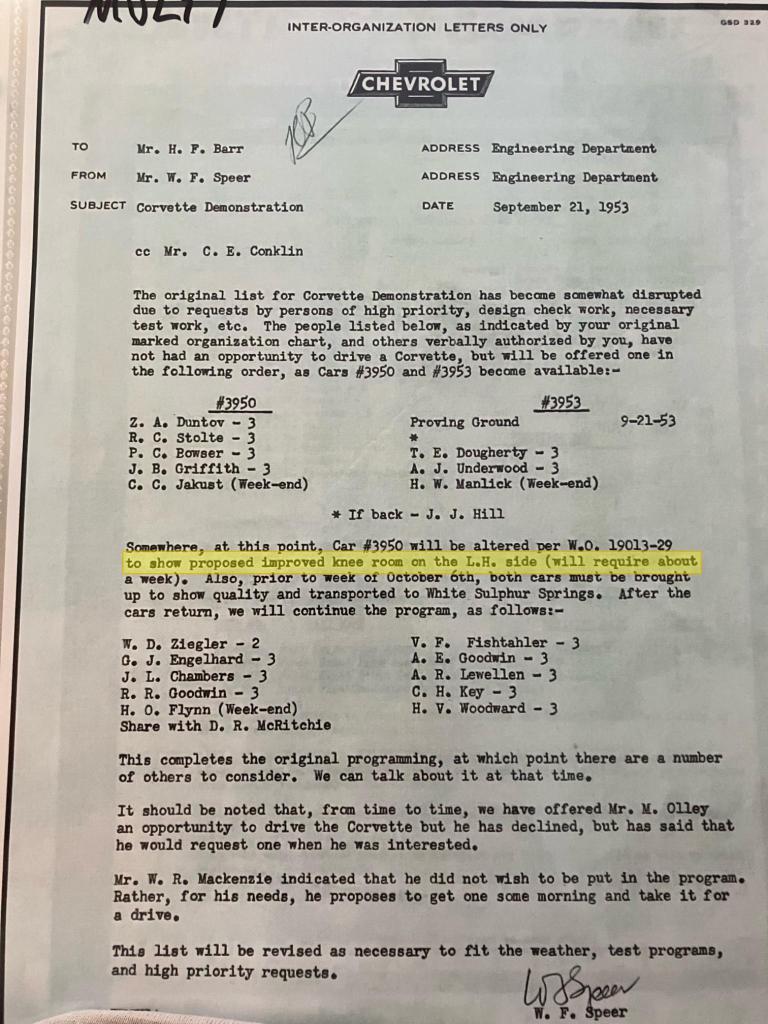
September 21, 1953 Chevrolet Engineering memorandum directing that Car #3950 be altered under Work Order 19013-29 to demonstrate improved driver knee room.
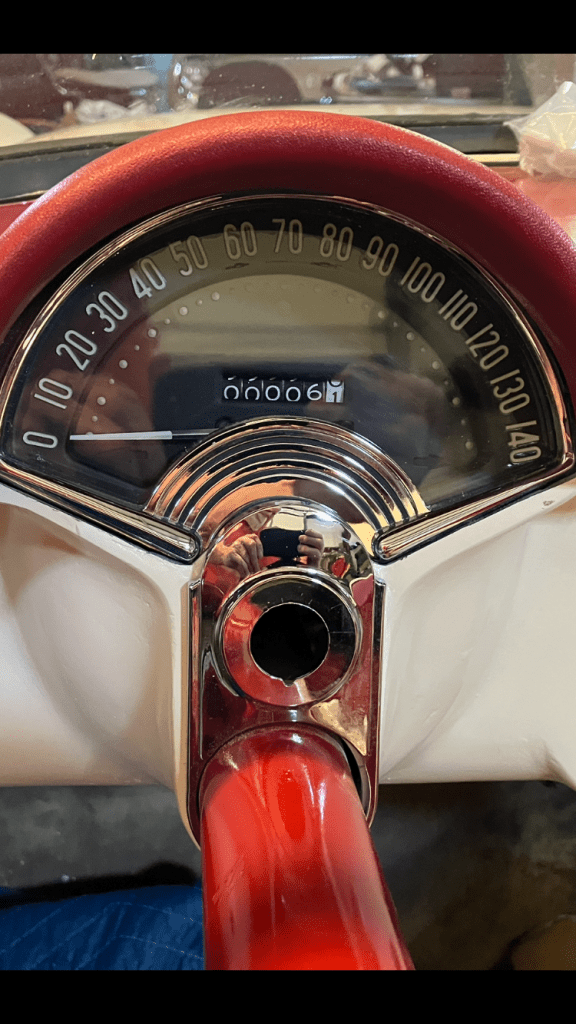
Standard steering-column positioning in Corey Peterson’s 1953 Corvette #073, shown for comparison with the raised steering-column positioning and enlarged dash opening on Car #3950.
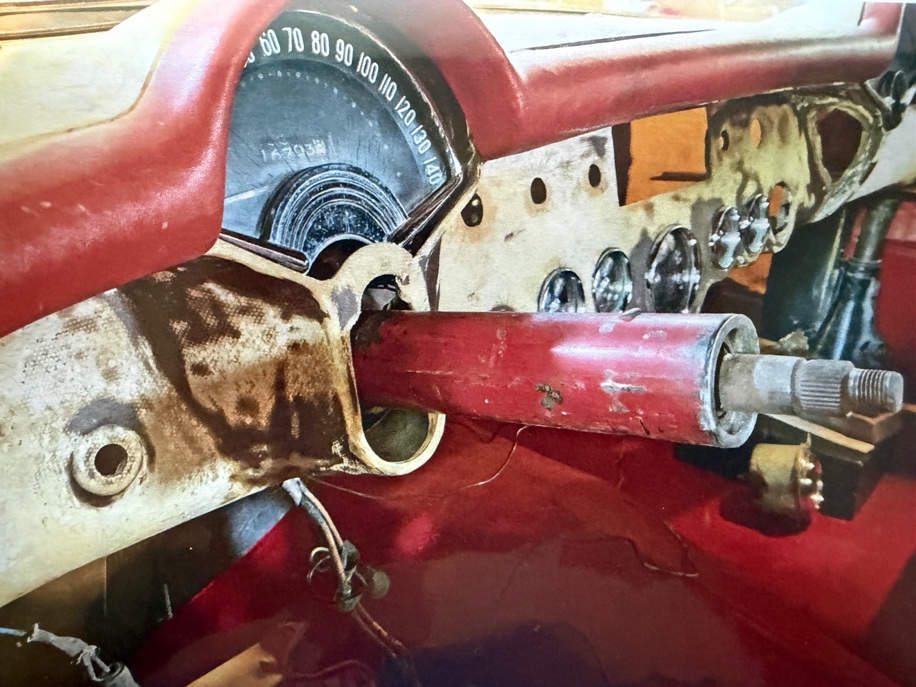
The enlarged dash opening and raised positioning of the steering column on Corey’s car.
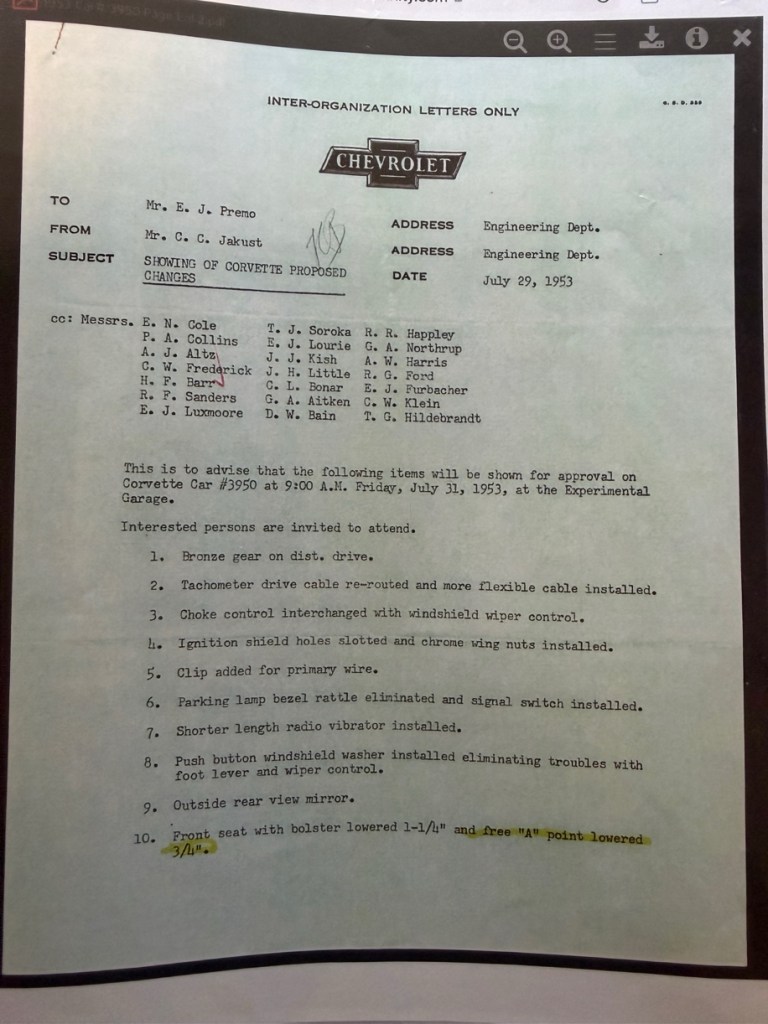
Jakust’s July 29 memorandum includes the request to lower the seat platform—the “A” point—by 3/4 inch.
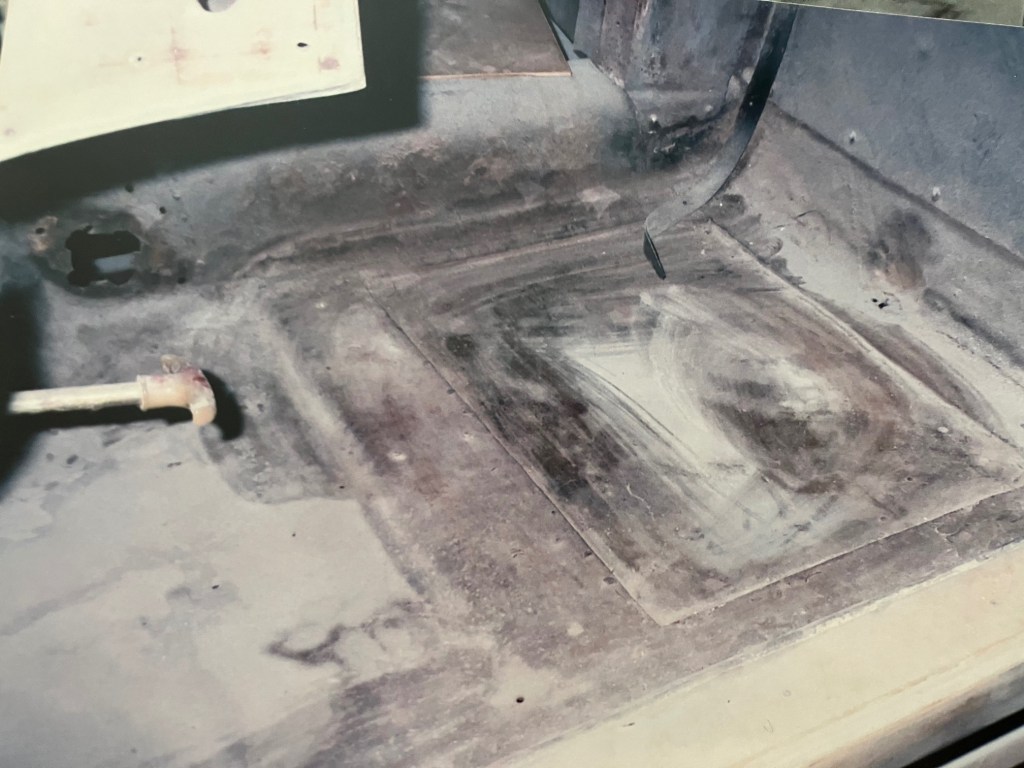
The lowered seat platform photographed by Lloyd Miller more than twenty years ago, during the car’s unfinished restoration in Tulsa.
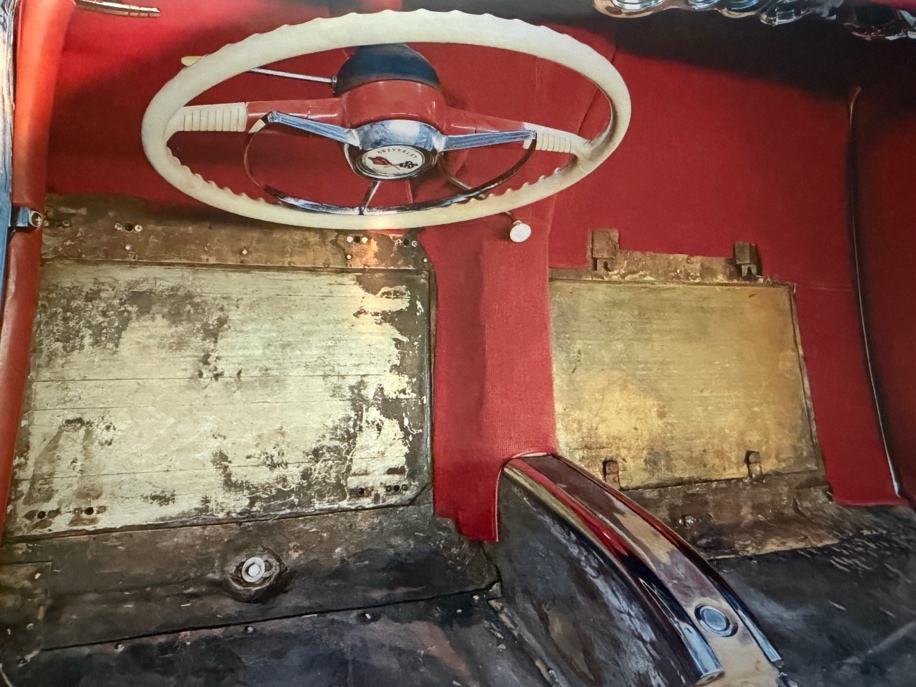
The floor modification on Corey’s car today. The “A” point is lowered precisely 3/4 inch.
Gas-Filler Box and Door
The original gas-filler door hinge folded down into the filler-box cavity, directly interfering with access to the gas cap. The original arrangement shows the problem Chevrolet was trying to solve; the revised configuration on Corey’s car shows the engineering response.
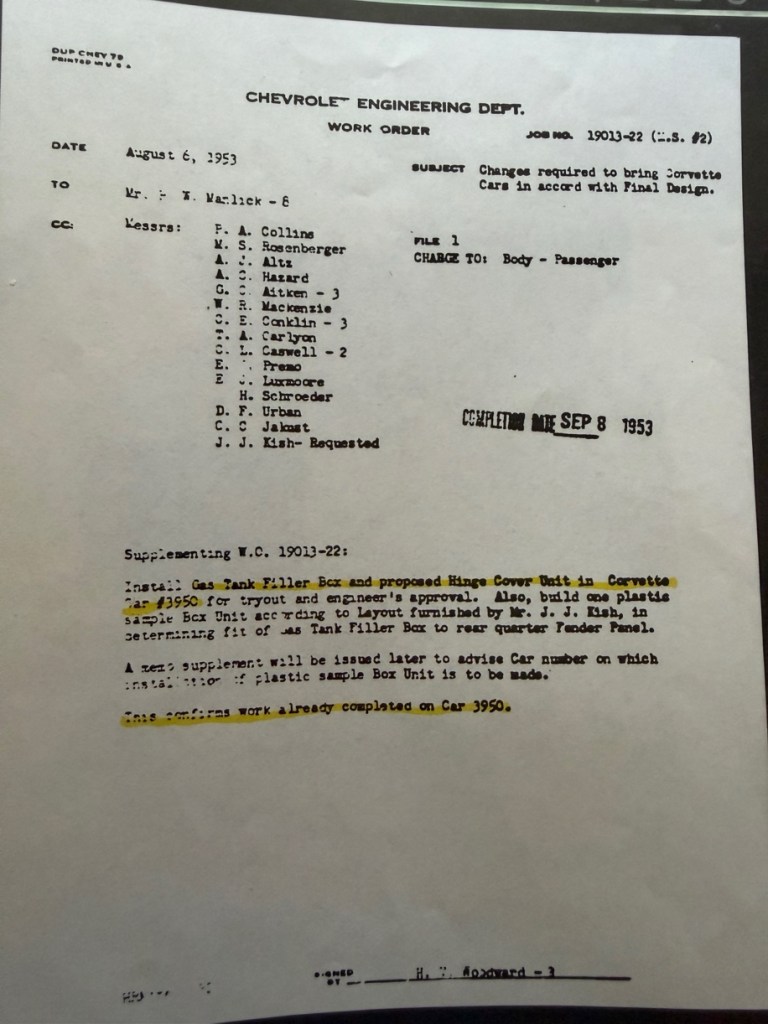
Chevrolet work-order supplement authorizing the revised gas-tank filler box and hinge-cover unit on Car #3950.
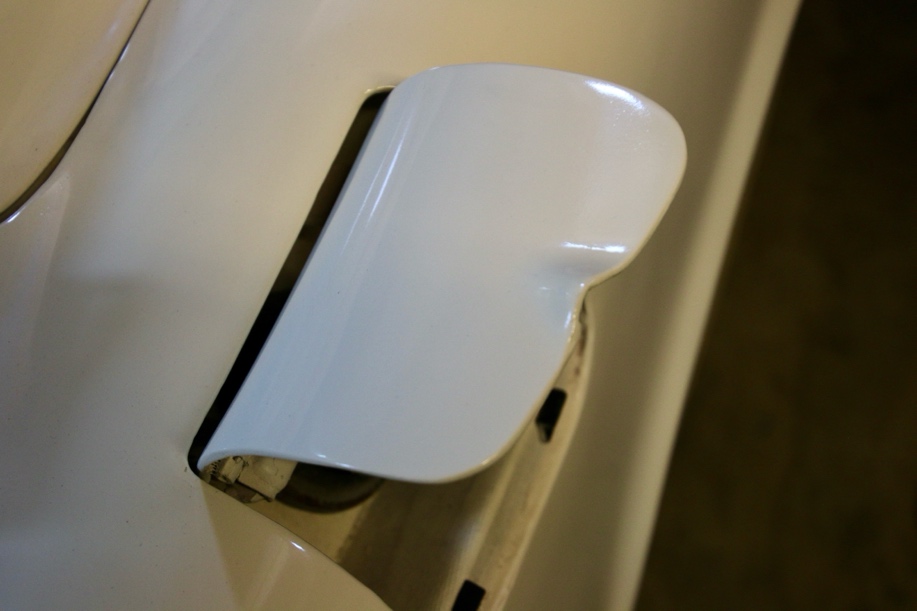
Exterior view of the original early gas-filler door arrangement.
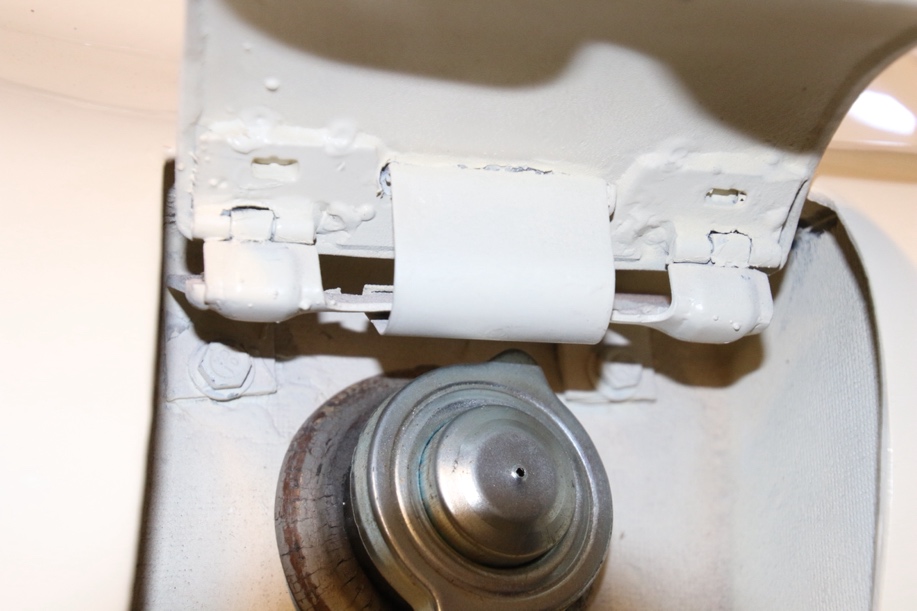
Original hinge arrangement inside the filler-box cavity. The hinge used was a modified Chevrolet passenger-car hinge.
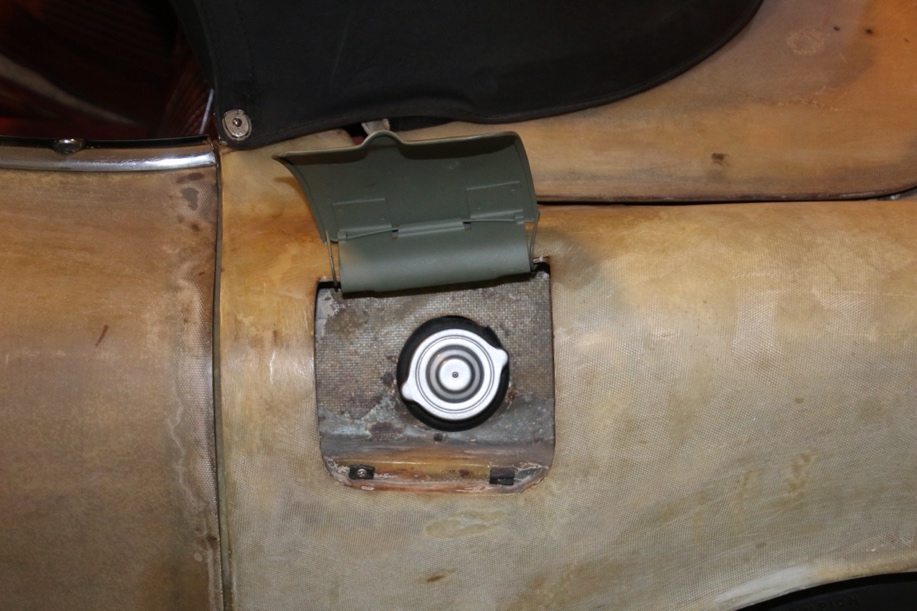
The revised design on Corey’s car. The door moves up and over the body panel, clearing the gas cap.
Trunk-Latch and License-Box Area
The original construction used roughly a dozen rivets around the mounting plate for the trunk latch and lock assembly. Here again, the Chevrolet document and the surviving body tell the same story: a rough early construction detail was reworked into the cleaner four-rivet arrangement still visible on the car.
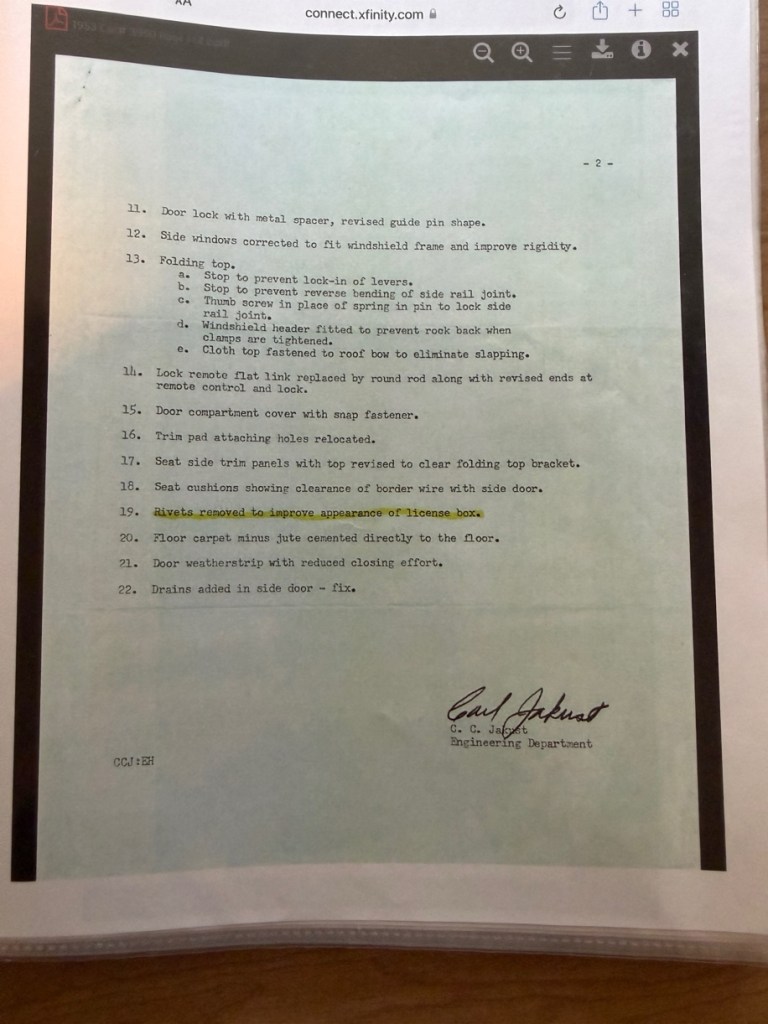
Jakust’s July 29 memorandum, page 2, includes the instruction to remove rivets to improve the appearance of the license-box area.
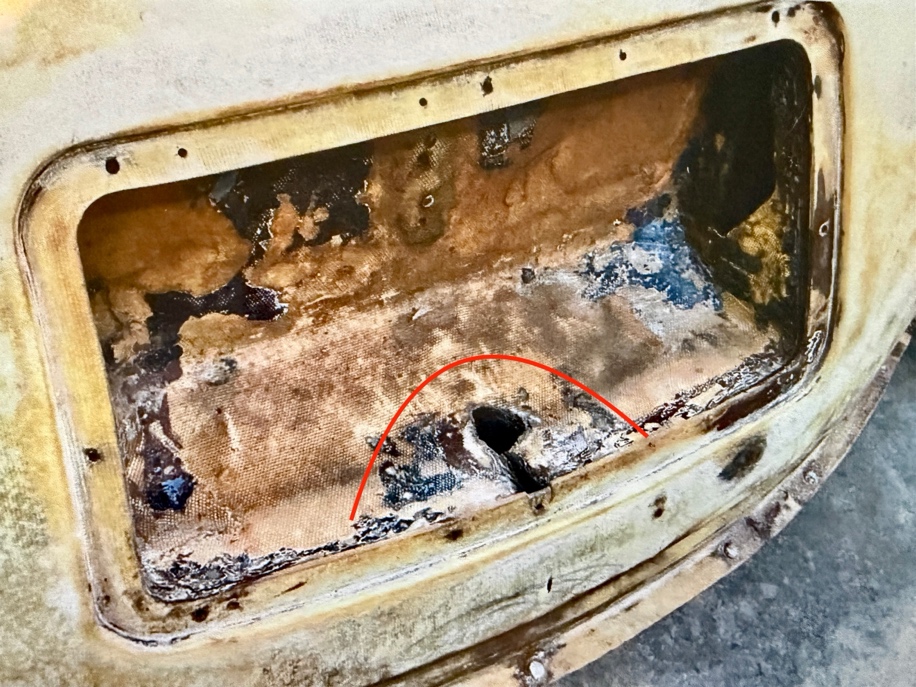
The rear license-box opening on Corey’s car. The half-circle identifies the larger area around the trunk-latch mounting plate that was altered when roughly twelve rivets were reduced to four.
Inside Rear-View Mirror Reinforcement
The complaint identifies the vibration problem, while the surviving mounting evidence beneath the dash shows where Chevrolet’s reinforcement was installed.
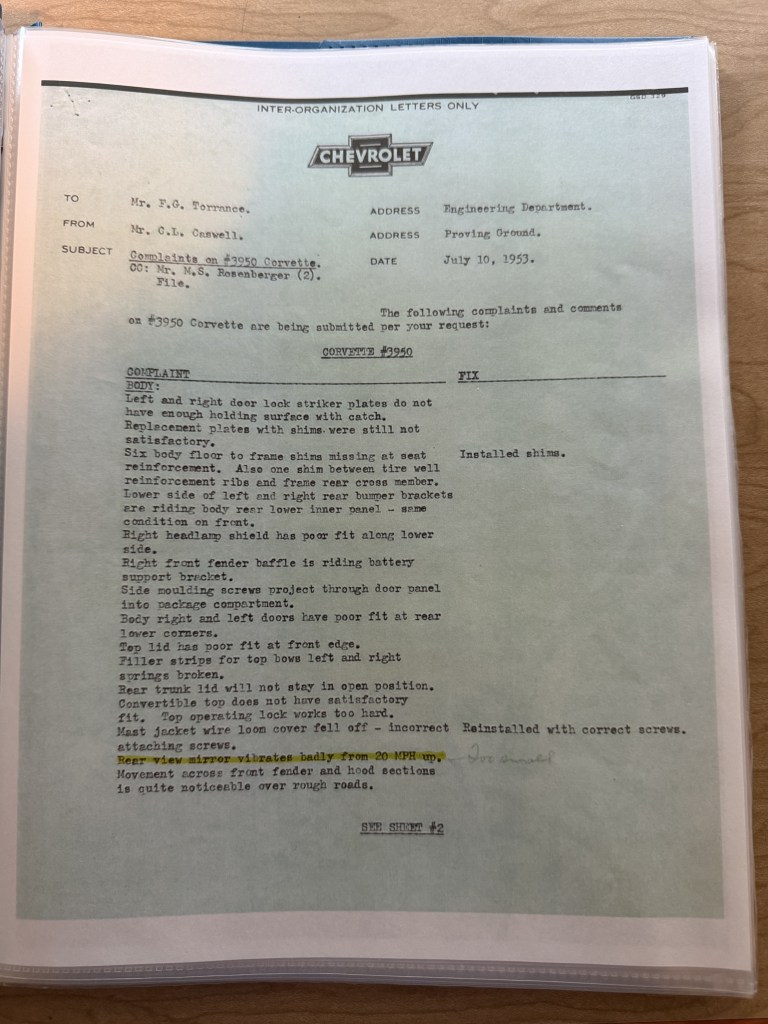
Chevrolet complaint record noting that the inside rear-view mirror vibrated badly above 20 mph.
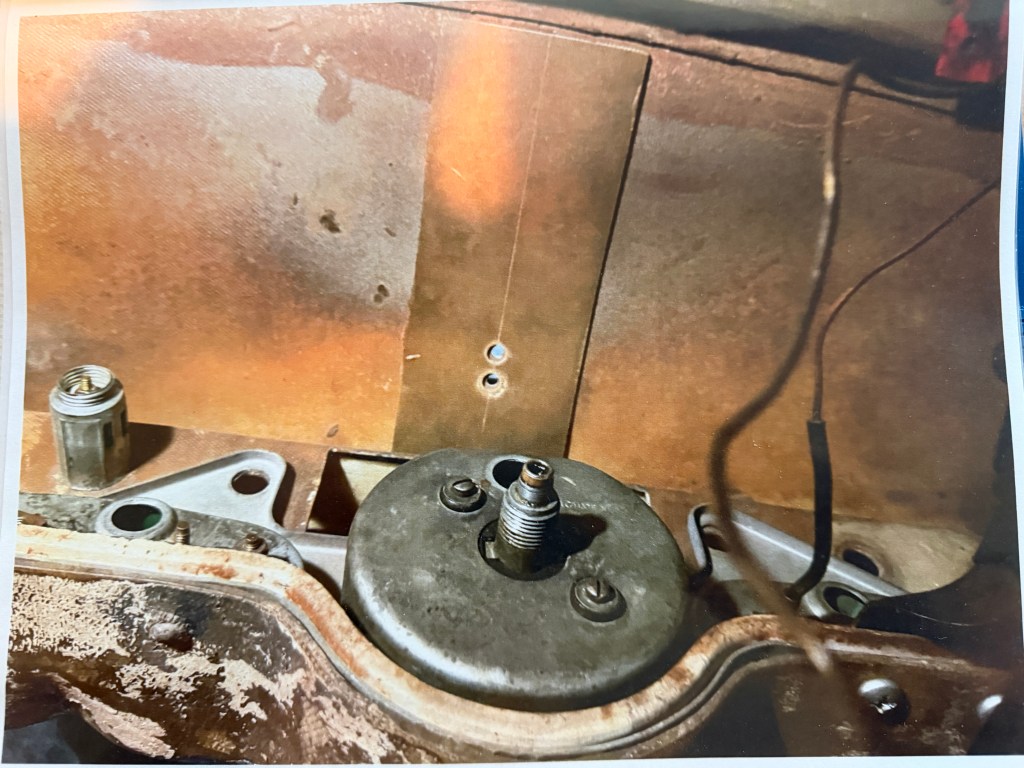
Physical mounting evidence beneath the dash on Corey’s car where the reinforcement strap was attached.
Motion-Picture Camera Mount
Not every modification was intended for later production. A September 8, 1953 work order authorized assistance in mounting a motion-picture camera on Car #3950 for a motion picture to be used for an SAE presentation. Unlike the production-oriented changes, this modification was made for a specific engineering assignment—and the four mounting holes remain visible in the deck lid.
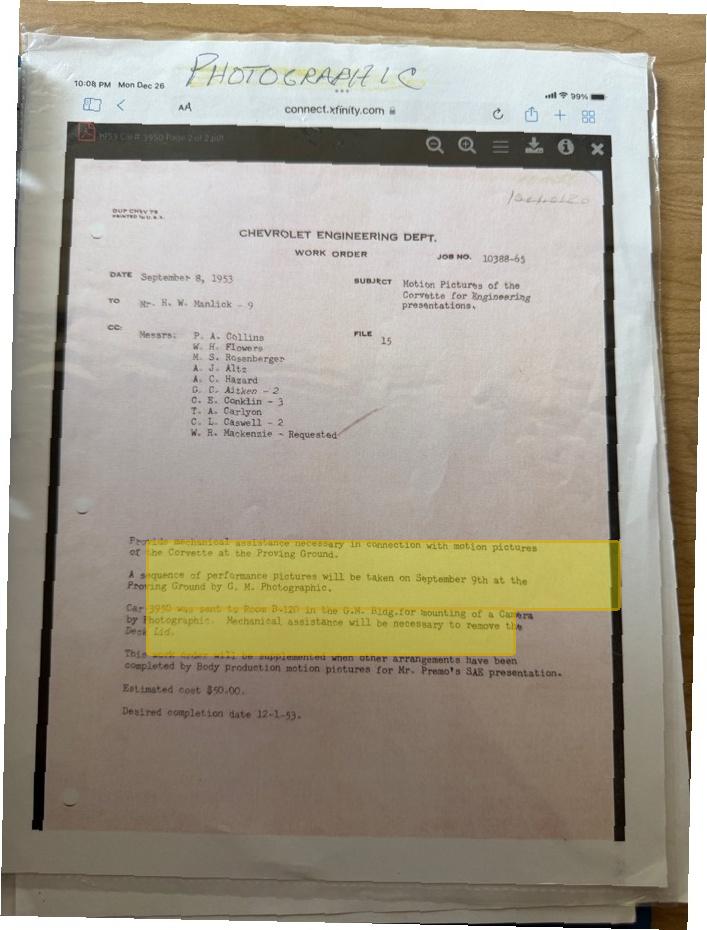
Chevrolet Engineering Work Order 10388-65, dated September 8, 1953, authorizing the motion-picture camera installation on Car #3950.
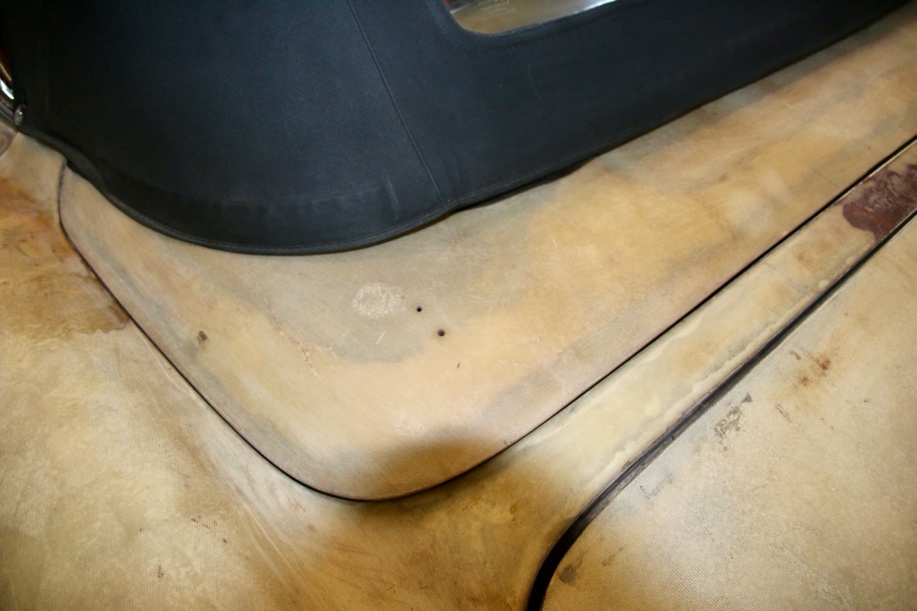
Camera-mount holes in the deck lid of Corey’s car.
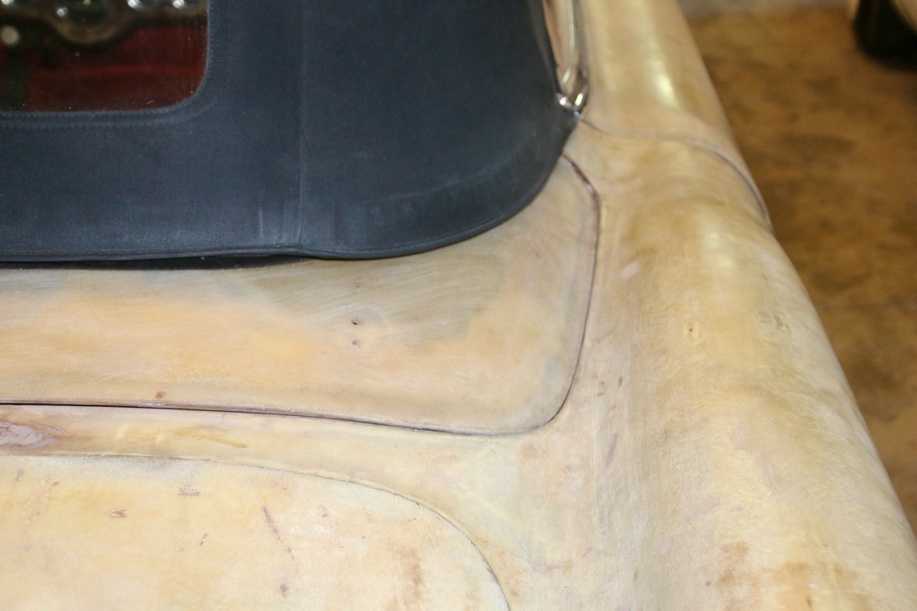
Closer view of the camera-mount holes.
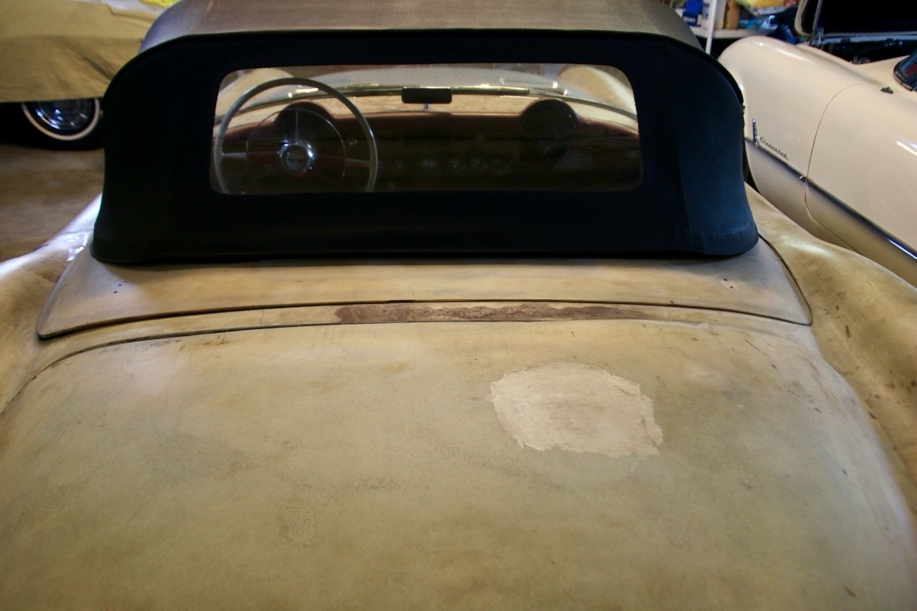
View showing all four deck-lid mounting holes.
Chevrolet used internal engineering numbers and production VINs as separate systems. The VIN plate associated with the Tulsa body reads E53F001001.
No known Chevrolet document has yet been found that places #3950 and E53F001001 together on the same page. However, Chevrolet’s records provide two important reference points. Its 1953 technical information states that the fourth Corvette built at Flint would carry serial number E53F-001004.
Separately, a Chevrolet requisition directly identifies Engineering Car #3953 as E53F001007—the seventh production Corvette. Those records establish the production sequence at both #4 and #7. Since Chevrolet repeatedly identified Engineering Car #3950 as “#1 production,” the corresponding serial number would be E53F001001. No single surviving document has yet been found that places #3950 and E53F001001 on the same line, but Chevrolet’s own records point consistently to that conclusion.
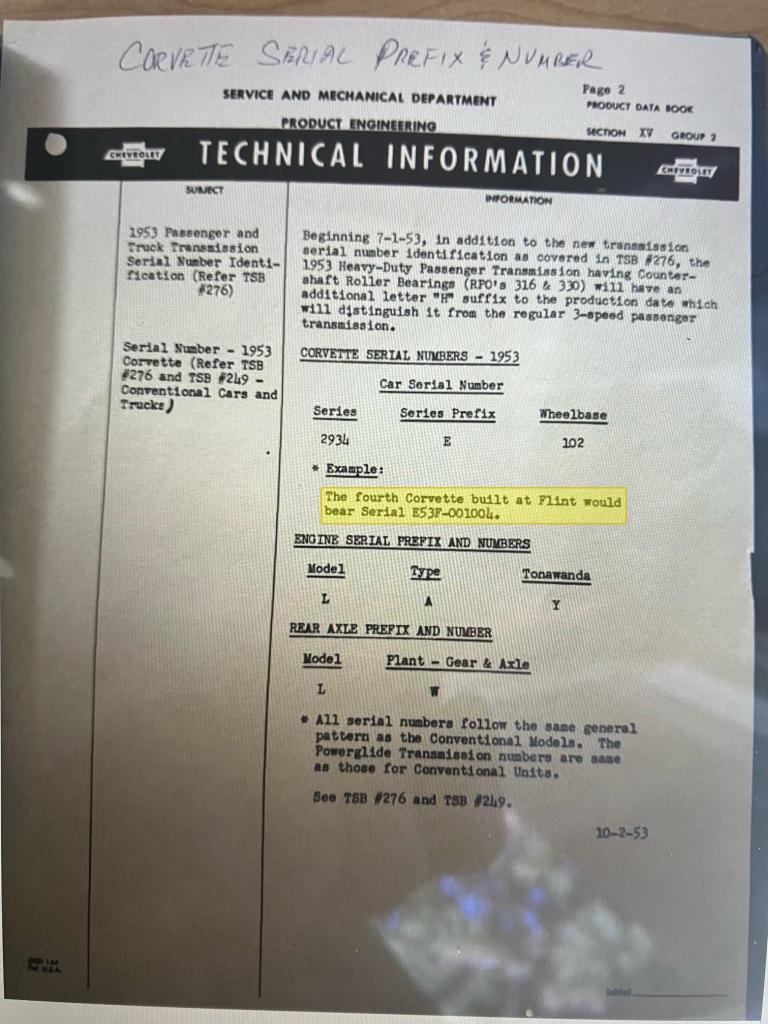
Chevrolet technical information explaining the 1953 Corvette serial-number sequence and identifying E53F-001004 as the fourth Corvette built at Flint.
The VIN Plate
When Corey Peterson purchased the disassembled Corvette, the VIN plate was among the parts in the boxes that came with the car. It was later attached to the driver’s door jamb with screws. During the first eight years of Corvette production, VIN plates were mounted with two screws and were routinely removed during paint work, repairs and restorations. It wasn’t until mid-1960 that Chevrolet began attaching VIN plates more permanently. Because those early VIN plates were attached with screws rather than permanent fasteners, the way the plate is attached today doesn’t prove it’s original—but it doesn’t prove it isn’t, either.
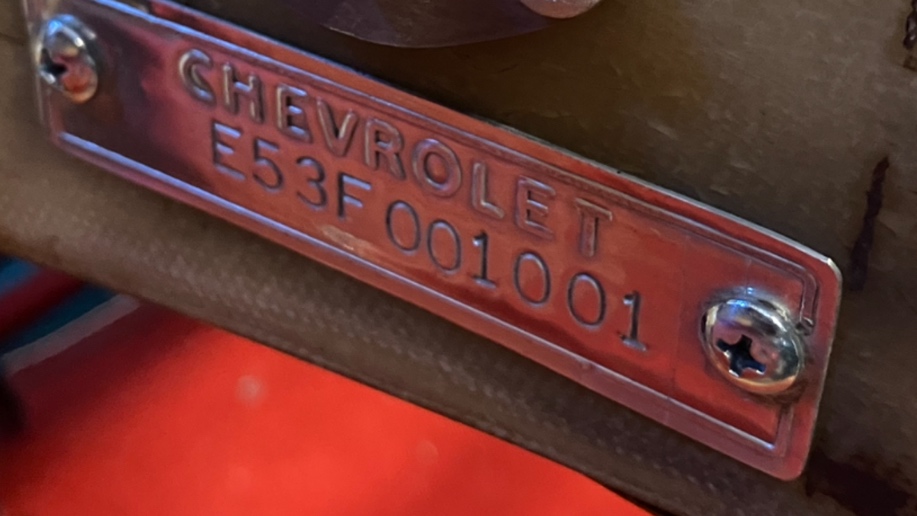
The VIN plate associated with the Tulsa body: CHEVROLET E53F001001.
That’s why some skeptics will naturally question the VIN plate. It’s a fair question. But the conclusion presented in this article isn’t based on the VIN plate alone. It’s based on the entire body of evidence—the Chevrolet Engineering documents, the documented engineering changes, the unique construction features of the car, and eliminating the other candidates.
Provenance: How the Tulsa Car Survived
The known provenance does not identify the body by itself, but it helps answer another question: Did this Corvette suddenly appear only after Corey assembled the #3950 documents?
The answer appears to be no. The body had been disassembled for decades and sat at Lloyd Miller’s Tulsa restoration shop for nearly twenty years before Corey connected the engineering paperwork to it. Photographs taken during prior ownership, before the car entered the restoration shop, show that several unusual body features were already present. At the time, those features were visible, but their significance was not yet understood because the supporting Chevrolet Engineering records had not been assembled.
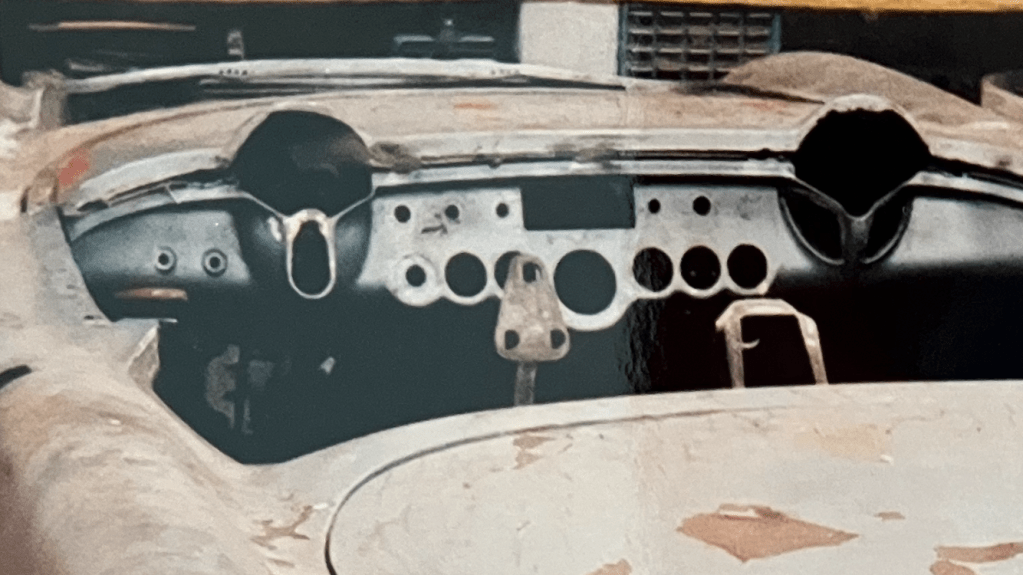
Dashboard area photographed during prior ownership, showing the altered steering-column opening and related modifications already present before later restoration work.
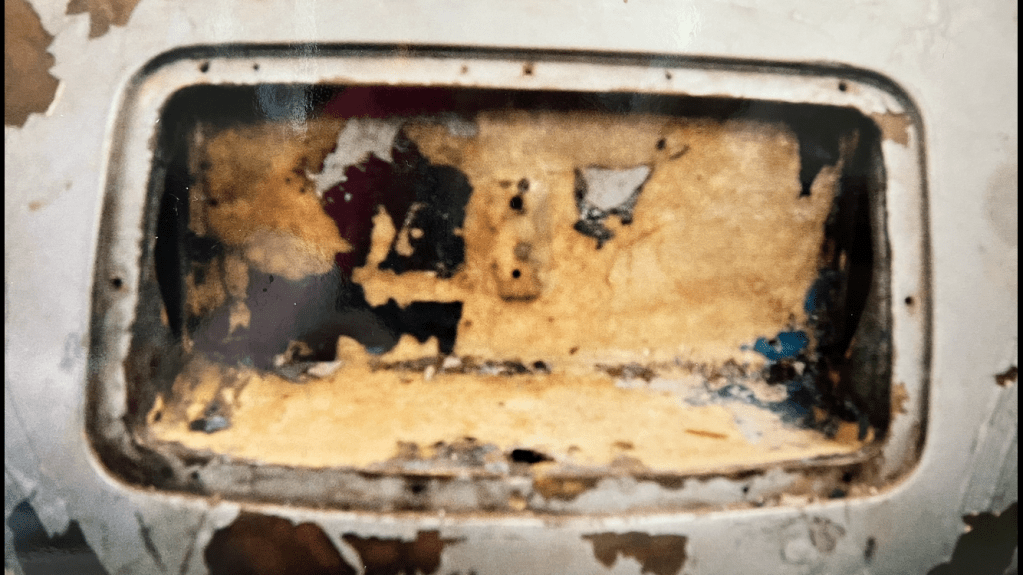
Rear license-box and trunk-latch area photographed during prior ownership, showing that the unusual body construction was already present.
When Corey retrieved the car from Tulsa, it remained disassembled and unfinished. The same unusual body features visible in the earlier photographs were still present, creating a visual timeline that predates Corey’s identification of the car through Chevrolet’s records.
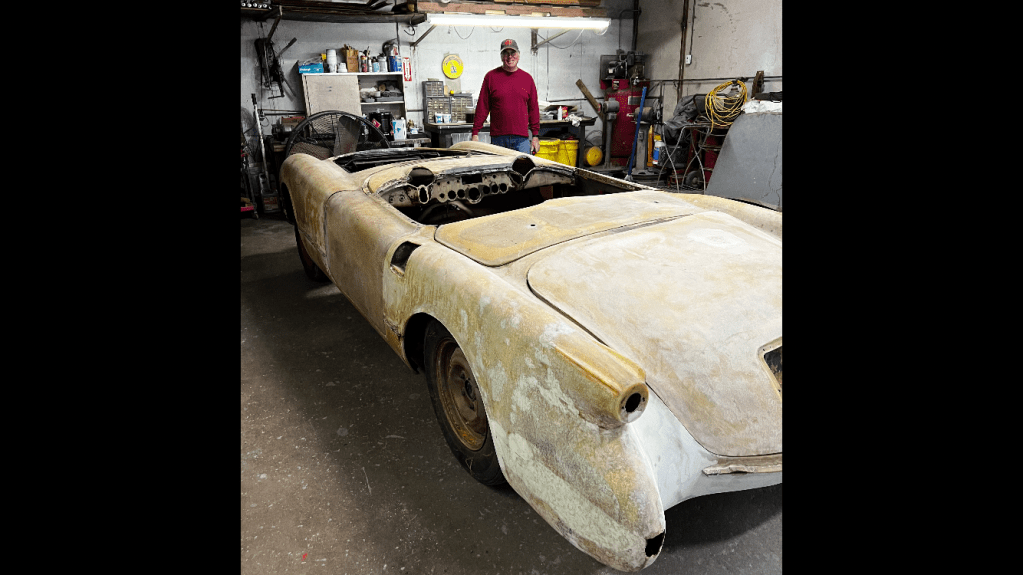
Corey Peterson’s Corvette as it appeared when he retrieved it from Tulsa after years in an unfinished restoration. The body’s unusual features were already present on the car, including the fuel filler door. Note: Lloyd Miller in background of his shop.
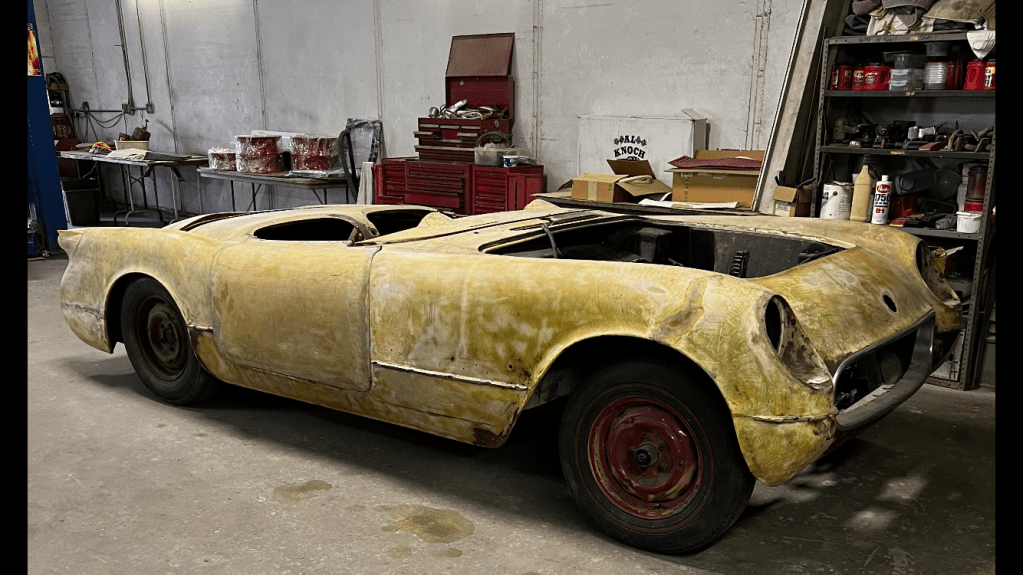
The car at the time Corey took possession in Tulsa, still disassembled and unfinished.
The earliest identified private owner was a woman in South Euclid, Ohio, in the 1970s, who represented the car as E53F001001. There remains a gap between the car’s last known GM activity and its appearance in the 1970s. The Manufacturer’s Statement of Origin was processed by Chevrolet Motor Division rather than by a delivering Chevrolet dealer, indicating the car entered company service instead of normal dealer distribution. The MSO would ordinarily have been surrendered when the first state title or registration was issued and would not be expected to survive. When Corey later acquired the car, he obtained a valid title through the customary lost-title process, including a bill of sale and state inspection of the car and serial number.
Questions Every Reader Should Ask
Could the VIN Plate Have Been Moved?
Yes. The fact the plate was among the loose parts that came with the car makes that a fair question. But the way the plate is attached today does not prove it is original, and it does not prove it is not. The plate has to be considered with the body’s construction, the documented engineering changes, Chevrolet’s records and the histories of the other early cars.
Does the Replacement Frame Disqualify the Car?
It affects originality, but not necessarily identity. Chevrolet records show that frame changes did occur among the earliest cars. The central question remains which fiberglass body survives.
Does the Replacement Engine Matter?
It matters to the car’s present configuration and restoration history, but it does not identify the fiberglass body Chevrolet modified in 1953. A February 1954 record also documents removal of #3950’s original engine. The car currently has a period-correct engine installed.
What About the NCRS?
Corey Peterson currently serves on the NCRS National Board as a Regional Director. He has repeatedly asked fellow NCRS officials, judges and members most knowledgeable about 1953 Corvette history to examine the car and review the supporting records. According to Corey, those who responded generally said they did not feel adequately informed to make a determination about a car this unusual.
The issue is not that the evidence has been rejected. It is that NCRS has no established process for evaluating a car like this. Its judging system is designed to determine whether a production Corvette has been restored correctly—not whether an early engineering and development car can be identified by bringing together factory records, documented changes and the surviving car itself. Corey has not asked anyone to accept his conclusion without examination. He has asked knowledgeable people to inspect the car, study the Chevrolet records and determine where the evidence leads. And no one would welcome a careful, qualified and independent examination more than Corey Peterson.
Conclusion
No single document, engineering change or physical feature can answer a question this important by itself. But when all of the evidence is placed together, it tells a remarkably consistent story.
The one-piece floor pan is an important place to begin. It is not cosmetic, trim or a bolt-on part that could easily have been moved from one car to another. It is a major functional part of the fiberglass body itself—essentially the foundation on which the rest of the body was built.
Its presence places Corey’s Corvette among the first twenty production Corvettes. Corey has documented where the majority of those first twenty cars currently reside. Eighteen are accounted for or documented, while the two whose present survival is not fully established were not among the six engineering cars identified in GM documentation. That does not prove the Tulsa body is #3950, but it narrows the possibilities significantly.
But the floor pan only tells us how early the body is. The engineering changes help tell us which early car it may be.
Chevrolet’s own records repeatedly return to Engineering Car #3950. It was requisitioned as a production-model development car to replace experimental Corvette #856. As the first production car, it became Chevrolet’s primary test vehicle, generating complaints that led to suggested changes, engineering evaluations, work orders and modifications. Most importantly, Chevrolet later referred to it directly as:
“Car #3950 (#1 production).”
Many of the changes described in those records can still be seen on Corey Peterson’s car today. They include the lowered “A” point and seating position, the enlarged steering-column clearance, the redesigned gas-filler box and door, the reworked trunk-latch mounting area, the mirror reinforcement and the holes used to mount a motion-picture camera on the rear deck.
These are not simply unusual features that happen to appear on an early Corvette. They are physical responses to specific problems Chevrolet engineers identified, discussed and attempted to correct on #3950.
As Corey walked me through Chevrolet’s records, one thing became increasingly difficult to ignore. He had arranged the documents chronologically, and when viewed, the same engineering car kept appearing—first in a requisition, then in complaint reports, then in engineering memos, then in work orders. None of those documents was written to identify VIN 001. Together, however, they begin telling the story of the same engineering car—one Chevrolet’s own records repeatedly identify as #1 production.
There is still one distinction that must be stated honestly. No known Chevrolet document has yet been found that places Engineering Car #3950 and the complete serial number E53F001001 together on the same page. Chevrolet clearly identifies #3950 as “#1 production.” The conclusion that #1 production carried the first production serial number is the remaining inference.
But that inference does not stand alone. It is supported by the one-piece floor pan, the engineering changes still present in the body, Chevrolet’s repeated references to #3950, the histories of the other early cars and the fact no other known Corvette fits that complete pattern.
The question is no longer simply, “Could this be Engineering Car #3950?” It has increasingly become, “If this is not #3950, then which car is?”
History does not always give us every answer we would like. Sometimes all we can do is gather every piece of evidence we can find, put it together as honestly as possible, and ask which explanation best fits the facts.
After doing exactly that, I know where the evidence has led me.
In my opinion, Corey Peterson’s 1953 Corvette is Chevrolet Engineering Car #3950. Given the significant documented evidence, the inference that it is VIN E53F001001 has convinced me that it truly is VIN 001.
The search for Corvette’s first production car should not end with this article. It should continue until the Corvette community has looked carefully at the records, examined the car, and decided whether the evidence has finally brought us back to the beginning.
Because if this car is what the evidence says it is, then we are not simply recovering a missing chapter of Corvette history. We are standing in the presence of the car that began it all—the Holy Grail of America’s Sports Car: Corvette VIN 001.
Acknowledgments
This investigation would never have been possible without Corey Peterson. For years, Corey pursued a question many believed had already been answered, assembling Chevrolet engineering records, photographs, production information and physical evidence one piece at a time. His willingness to share that work and walk me through both the documents and the car made this article possible.
I also owe a sincere debt of gratitude to John Amgwert, whose lifetime of scholarship, leadership and commitment to historical accuracy helped establish many of the standards by which early Corvettes are studied today.
Historical Chevrolet documents reproduced in this article are courtesy of the GM Heritage Archive.
Finally, I want to thank everyone—whether they agree with the conclusion or not—who has spent time preserving Corvette history. Honest historical work depends on sharing evidence, asking difficult questions and being willing to follow the facts wherever they lead.
Author Note
Brad Burdick is a longtime Corvette enthusiast with a significant interest in the history of Corvette. He has owned C5, C6, C7 and C8 Corvettes. He considers Bob Bubnis, former Curator of Collections and Exhibits Manager at the National Corvette Museum, a friend and mentor in his passion for Corvettes. As stated throughout this article, I do not want this important issue to be left unresolved. It deserves continued attention rather than being quietly forgotten as a footnote in automotive history.
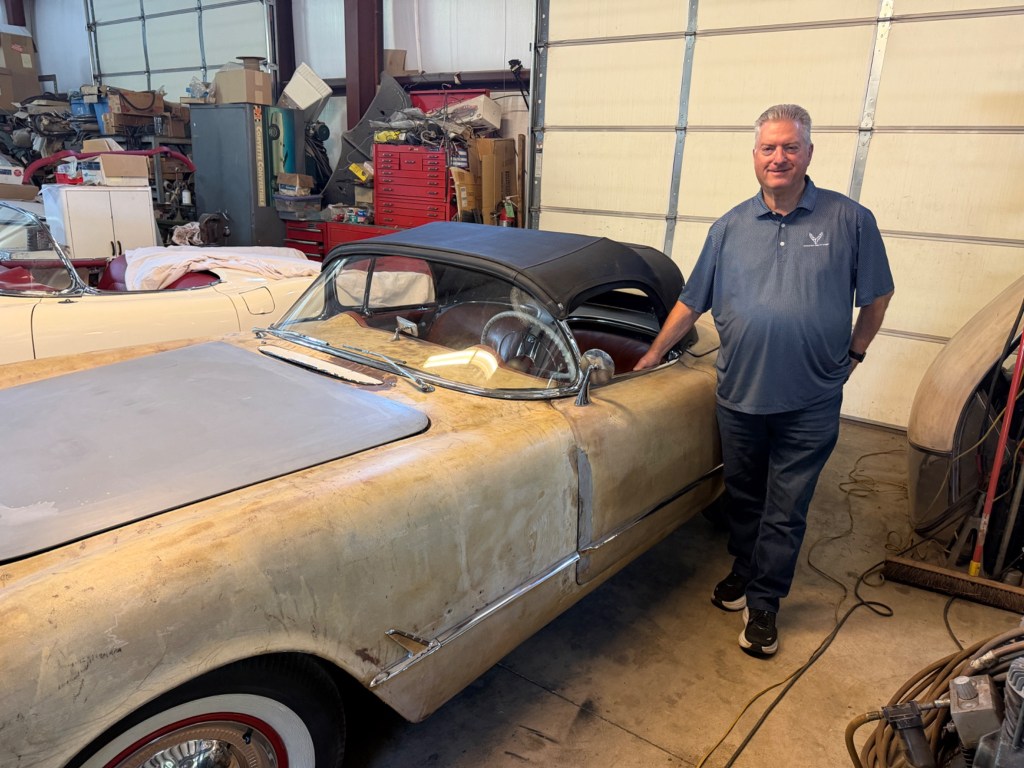
The author with Corey Peterson’s 1953 Corvette during his examination of the car and its supporting documentation.
Join the Discussion
We welcome your questions, comments, additional information, and differing perspectives. This site is intended not only to present the evidence, but to encourage thoughtful discussion and continue building the historical record of the first production Corvette.

